On Poetry Potlucks: Part II – Guest’s Perspective (Jeremy Ra)

Poetry Potlucks - Jeremy Ra's Perspective
“We picture poets in the fragile grasp of a nocturne at dawn . . . not munching on pasta and fish fillet. Yet here it was, unintimidating . . . basic.”—Jeremy Ra

Guest Curated By Neil Aitken

In this installment of “On Poetry Potlucks,” our guest curator Neil cedes the floor to one of his past potluck guests, Jeremy Ra, who reflects upon the significance that his first experience at a poetry potluck held for him as a writer.

* * *

To Eat Enough Was
made three seasons, summer
and winter and autumn third
and fourth spring when
there is blooming but to eat enough
is not.
—Alkman fragment 20, quoted in Men in the Off Hours by Anne Carson

“Dying” seems to precede almost any mention of poetry in the media nowadays, as if poets do not deal with death enough that we need to prepare for the imminent bereavement of the medium as a whole. We perceive this almost as an assault—cast as vanguards of the old, the out-of-touch that failed to catch up to the modern times. That it is begrudgingly, yet unquestioningly, recognized as “art” only makes matters worse. (“It’s an acquired taste,” I’ve heard. “I just don’t get it,” I’ve been told.) Its implications are great as it refines the most basic of tools we use to form a community, yet its efforts mostly fail to captivate a large audience. (“Doesn’t it need to rhyme?” I’ve been asked.) At times, it feels we shoulder this burden alone; chained Prometheus whose heart is poked out daily for his gift that furthered the human civilization.

I think that’s why I find most poetry workshops to have a feel of a support group veiling over them at all times. We are there to pay tribute to what most people in the outside world had forgotten. We hold the corpses of our poetic veterans in our hands as we read their works. We bid them well by trying to create something of our own that says some of us remember—let’s be honest here, you’re not at the happiest place on earth. Despite the invaluable kinship I felt with fellow poets (not to mention the impeccable feedbacks that transformed my poems from malformed placentas into near-swans), I fell into a workshop limbo and retreated my poems into the solitary confines.

Continue reading “On Poetry Potlucks: Part II – Guest’s Perspective (Jeremy Ra)”
On Poetry Potlucks: Part I – How to Start a Poetry Potluck

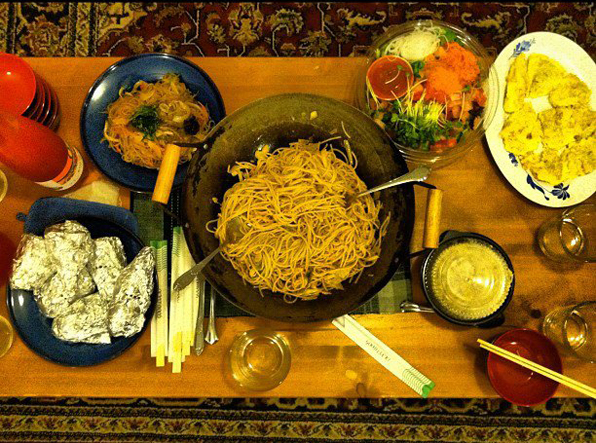
The table at a past poetry potluck (Photo by An Xiao)

A Guest Post by Neil Aitken

Neil Aitken
Neil Aitken

Editors’ Note: We welcome Boxcar Poetry Review editor and Issue 4 contributor Neil Aitken to the blog this summer as he guest-curates a short series for us about his poetry potlucks, a unique tradition combining food and literary community that he began several months ago in his L.A. apartment. Over the course of the next few weeks, Neil will be sharing about his experiences hosting and developing the concept of the poetry potluck, and may even invite a few of his past guests to share theirexperiences, as well.

In this week’s post, Neil discusses some of the background behind his poetry potlucks and provides some practical pointers about what it takes to host such a gathering. We hope that this post, as well as the rest of the series, will inspire you to carve out time to break bread with other members of the literary community where you live–and to maybe even begin a poetry potluck tradition of your own.

* * *

Whether you live in the big city or in a small town, writing tends to be a lonely labor and we often find ourselves craving opportunities to discuss our work and our interests with others who share a passion for literature and the arts.  Writing retreats like Kundiman and VONA are certainly helpful in providing us with safe spaces for sharing our work and inspiring us to innovate—they also provide us with the chance to meet fellow writers and artists who are exploring and challenging the contemporary literary landscape.  Once the retreat is over though, often, unless we live someplace with a significant population of our fellow participants, we’ll return home to our original communities and find ourselves back where we started (at least in terms of face-to-face contact).  While we may stay in touch with our new friends and peers through email and Facebook, these forms of contact still pale in comparison to time spent together.

One possible solution is to create our own spaces of sharing and interaction.   For the past several months, I’ve been doing this by hosting poetry potlucks in my little apartment in Los Angeles.

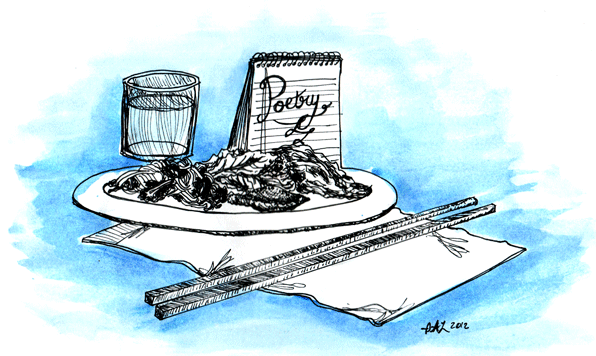
Potlucks are a powerful way of building community—they encourage sharing and interaction.  For my poetry potlucks, I ask each participant to bring a dish and a poem to share.  People often bring food that they’ve prepared at home, but it’s also perfectly fine to bring something store-bought.  My neighborhood is full of great restaurants, bakeries, and grocery stores, so even a late arrival can pick something up on the way in.

Likewise, there are no fixed rules about what type of poetry needs to be shared.  I let my guests know that the potluck isn’t a formal workshop—they are welcome to bring something finished that they want to share as a way of introducing others to their current projects, or they can bring copies of something they want feedback on.  The emphasis should always be on dialogue and exchange—a poetry potluck promotes active and engaging discussion, book and movie recommendations, brainstorming, and hopefully a fair bit of cross-pollination and creative inspiration.

These poetry potlucks have been a big hit here in Los Angeles—largely because they fill a vital role, providing a space where community is born and fostered.   Here are some suggestions and tips I’ve learned over the past year’s worth of poetry potlucks.  Hopefully these ideas will be helpful to you if you’re interested in creating a poetry potluck or something similar in your own community.

Continue reading “On Poetry Potlucks: Part I – How to Start a Poetry Potluck”

Summer Reads: W. Todd Kaneko’s Top Three

Today’s list (the third installment in this year’s Summer Reads series) comes from Issue 2 contributor W. Todd Kaneko. He writes:

here’s a list for you [. . .]

Let Me Clear My Throat by Elena Passarello (Sarabande Books)
Murder Ballads by Jake Adam York (Elixir Press / Crab Orchard Award Series in Poetry)
Galerie de Difformite by Gretchen E. Henderson (Lake Forest College Press)

Writers I know, writers I don’t, books that are new, books that are new to me, essay, poem, labyrinth, ventriloquist test, dead people, QR codes, famous screams, history lessons, fake choose your own adventures, pages and pages of bad-assery.

Any reading list that promises “pages and pages of bad-assery” sounds intriguing to us!  Many thanks to Todd for sharing these titles.

* * *

For more, read Todd’s “Northwest Poem” in Lantern Review, Issue 2.

To see the rest of this series (and find out what else our contributors have been reading this summer), click here.

What have you been reading this summer? Leave us a comment or drop us a line on Facebook or Twitter to let us know.


Summer Reads: Maria Allocco’s Top Three

This week’s list comes from Issue 1 contributor Maria Allocco, who writes that the three titles she’s most excited about this summer, “in order of digestion,” are:

Shamanism As A Spiritual Practice for Daily Life
By Tom Cowan (Random House)

In my quest to meet my Guides and power animals, I plan on using this as a guide. As I have been in San Francisco now for almost a decade, I may fully initiate myself by buying a bongo.

Beneath The Lion’s Gaze
By Maaza Mengiste (Norton)

Maaza read an excerpt at a VONA reading in Berkeley last week, and I started her book over a badass organic burrito that night.

A Course in Astral Travel and Dreams
By Beelzebub

Lucid dreaming was one of my favorite nighttime activities in college. Now I hope to journey again, sans the 25 page paper interruptions.

Many thanks to Maria for sharing her list with us!

* * *

For more, read Maria’s poem, “Downstairs,” in Lantern Review, Issue 1.

To see the rest of this series (and find out what else our contributors have been reading this summer), click here.

What have you been reading this summer? Leave us a comment or drop us a line on Facebook or Twitter to let us know.

LR News: Last Chance to Submit for Issue 5 (The Hybridity Issue)!

LR Issue 5: "The Hybridity Issue" - Call for Submissions
Click to Submit to LR Issue 5

Happy Friday, everyone!

A reminder that our reading period for Issue 5 will be closing this Sunday, July 15th, at 11:59 PM EST. This will be the last chance to submit for The Hybridity Issue, so please don’t forget!

Click here to access the special submissions guidelines for this issue (the link to our online submissions form can be found at the bottom of the page).

Many thanks and good luck; we look forward to reading your work.

Cheers,

Iris & Mia

LR News: Vikas K. Menon on Pocket Broadsides

Pocket Broadside #7 - Vikas K. Menon
Pocket Broadside #7 – Vikas K. Menon

A poem by Lantern Review contributor Vikas K. Menon is up on Pocket Broadsides today. Click here to read it on Tumblr!

To see all of the Pocket Broadsides that have been posted on Tumblr thus far, visit the project’s main page at pocketbroadsides.tumblr.com. To read each new piece as soon as it is posted, follow us on Tumblr, or subscribe to the RSS feed.

Summer Reads: Kimberly Alidio’s Birthday Reading List

Welcome to the 2012 edition of our Summer Reads blog series, in which past Lantern Review contributors give us a peek at what’s on their reading lists for the current summer season. This year, we decided to change things up a bit: instead of posting longer lists as we have in the past, we’ve asked our contributors to select the top three titles that they’re excited about this season and to write in about them. Throughout July and August, we’ll be sharing the Top Three lists that they’ve sent us on the blog.

This week’s Top Three comes from Issue 2 contributor Kimberly Alidio, who wrote us the following note on her birthday (July 9th):

July 9, 2012

Hello LR!

Thank you again for the invitation to share my summer reading list.

I just finished Scott Morgensen’s Spaces Between Us: Queer Settler Colonialism and Indigenous Decolonization (University of Minnesota Press, 2010), which demonstrates that neither scholarly questions nor queer decolonizing politics have to be “special interest” matters but instead good tools for anyone who seeks justice. Generous, thoughtful writing makes all the difference. Reading this helped me finish a research essay just last Friday.

Yesterday, I went to the Lucian Freud retrospective at the Fort Worth Modern and meditated quite a while with the textures of each face and figure. Maybe some ekphrastic poems will arise alongside Sarah Howgate, Lucian Freud Portraits (National Portrait Gallery, 2012). The huge exhibition catalog was a really necessary splurge since no photography was allowed in the huge exhibit, and I’m an obedient museum-goer. Less Instagram posts, more books!

Today is my birthday and my brother got me what I asked for: Cecilia Vicuña’s Saborami (Chainlinks, 2011), a book of daily poetry and object-making in response to military dictatorship first published in 1973 Chile. A good practice for us today.

Til next year — wishing you joy and ease —

Kimberly

Many happy returns, Kimberly! Thanks for sharing your list with us.

* * *

For more, read Kimberly’s poem “translation” in Lantern Review, Issue 2.

What have you been reading this summer? Leave us a comment or drop us a line on Facebook or Twitter to let us know.

Review: Karen An-Hwei Lee’s PHYLA OF JOY

PHYLA OF JOY
Karen An-Hwei Lee’s PHYLA OF JOY

A Guest Post by Eugenia Leigh

Phyla of Joy by Karen An-Hwei Lee | Tupelo Press 2012 | $16.95

Eugenia Leigh
Eugenia Leigh

When entering Karen An-hwei Lee’s mysterious world of silver eucalyptus groves and Holy Spirits, the temptation is to dissociate. To keep that ethereal realm separate from the mud-and-waste Earth most of us know. But Lee’s power lies in her ability to unite both worlds. Instead of distancing the Divine from cigarettes and kitchen fires, Lee welcomes the one into the other. But the startling result isn’t a third world tangled with dichotomies. The result is Phyla of Joy, a portrait of the world we live in, but reclaimed through gracious eyes that somehow inject light into everything from famine to girls born with cleft palates.

Lee prepares her reader for this new world with her epigraphs, the first of which comes from a Davidic psalm: “For with You is the fountain of life; / in Your light we see light.” Immediately, the following formula is established: to find light on Earth, Lee’s poems—and we readers—will need to rely on the light of the divine “You.”

This “formula” seems simple enough, but how much effort does it really take for our generally afflicted human selves to seek out that otherworldly light? Lee addresses that tension between being human and craving something beyond-human in the book’s first poem, “Yingri.” In the Tupelo Press reader’s companion to Phyla of Joy, she notes that yingri is a Chinese word composed of two characters. While Lee tells us that the second character translates to “sun,” she allows the meaning of the first character to remain ambiguous in its multiple possible translations: “shadow,” “eagle,” “to reflect.”

The poem’s two stanzas add to our understanding of yingri’s duality. The first stanza, representative of earth and ying with its many meanings, reads:

Inside me is a bridge, or the beams of a house,
and an old ground swell beneath a garden boat.

The speaker’s observations in this stanza reflect the multiple meanings of ying with the word “or,” which reveals both the speaker’s uncertain sense of her human self and also the possibility of additional manmade constructions buried within her.

The second stanza constitutes ri—the sun and its associations with divinity:

Outside, on an acre of snow,
a winter sun, blinding.

What appears to be a small, four-line opening poem speaks volumes when pitted against the rest of the collection. We asked earlier how people can invite supernatural light into a worldly existence. And here is the answer: by blinding.

Continue reading “Review: Karen An-Hwei Lee’s PHYLA OF JOY”

Friday Prompt: Hybrid & Heterogeneous

LR Issue 5: "The Hybridity Issue" - Call for Submissions
Click to Submit to LR Issue 5 | Deadline: July 15, 2012

Since we’re approaching the end of our Issue 5 reading period, today’s prompt will be our final discussion on the critical notion of hybridity.  Click here for previous posts, which discuss a number of ways we’ve seen contemporary practitioners experiment with hybrid forms, media and language.  Today’s prompt focuses on subject matter derived from hybrid sources, which I’d like to approach through a consideration of Quan Barry‘s poetry.

In an interview for Perihelion, Barry says:

I listen to a lot of NPR, mostly FRESH AIR, and quite a few of the poems [in Asylum] are from segments I’d heard either there or on ALL THINGS CONSIDERED. Because I’m the kind of person who’s really interested in making connections, in getting really into topics, for ASYLUM, I researched a lot of the poems (for example, the poems about syphilis).

One of these “poems about syphilis,” which appears in the sequence “Plague,” begins:

After three weeks a chancre forms–an ulceration
with a hard edge, springy center–the way a button
feels through a layer of cloth.  Also, the lymph nodes

in the groin begin distorting, swell like vulcanized rubber,
painless though immunologically ineffectual.

Continue reading “Friday Prompt: Hybrid & Heterogeneous”

Friday Prompt: Working With Hybrid Language

LR Issue 5: "The Hybridity Issue" - Call for Submissions
Click to Submit to LR Issue 5

This month, in preparation for Issue 5: “The Hybridity Issue,” we’ve dedicated our Friday Prompts to exploring how collage, mixing and hybridization can be meaningful (and generative) practices for poets interested in exploring the narratives and critical concerns of the Asian American community..  Thus far, we’ve looked at hybrid form and mixed media; today we’ll be talking about hybridized language.

In contemporary poetry, quirky mixtures of the high and low, archaic and contemporary, and the scientific and colloquial are so common that we’re no longer surprised when a writer quotes a religious text–the Bible, for instance–and then, without skipping a beat, relays the one-liner they heard while waiting for an oil change.  This kind of modulation, frequently used for ironic or comedic effect, can also be deployed for more serious purposes–and, I suspect, is a mode we’ve come to embrace because miscegenated language reflects our cultural moment in a way that elegant, seamlessly constructed prose does not.  Just Google “best place to get tacos” or “Jeremy Lin is awesome” and see what comes up.

For many Asian American poets, however, linguistic hybridity is more than just an intellectual exercise.  Many of us are multilingual, or come from families whose histories are told in multiple tongues (two, at least, and sometimes more–I’m thinking here of Korean-Brazilian writer Larissa Min, who writes in the linguistic spaces between Portuguese, English and Korean).  And even if our tongues aren’t split by language, the idea of linguistic difference–our grandparents’ English versus our own, our professors’ English versus our aunties’–is important for more than theoretical reasons.  It’s freighted with cultural, and thus, emotional weight.  Our split tongues matter–even if, as is the case for me, a fourth-generation Japanese American, our “mother tongue” is little more than a myth, a conspicuous silence that, in its marked absence, tells us something about our history. Continue reading “Friday Prompt: Working With Hybrid Language”