Becoming Realer: Looking at the Real

Becoming Realer: Identity, Craft and the MFA is a column that explores issues of poetry, theory and writing craft in relation to the personal experiences of Saint Mary’s College of California Creative Writing MFA candidate and LR staff writer, Kelsay Myers.

Rainbow shoes

I can’t remember if I imagined Korea as a child. I must have. I put the rainbow-striped shoes that were sent with me from Busan when I was three-months old high on a shelf in my bedroom, in a place where I could look at them but not touch them. Sometimes, I would ask my mother to take down the shoes, wondering if that would be the day they’d finally fit on my feet. That day never came. They were too big each time. I’d fall down trying to walk in them. Eventually I forgot about wanting to wear them, and when I did remember they were up on that shelf again, they were so small that they pinched my feet. I used to think the moral of this story was that the shoes never fit just right. That, in the same way, Korea would never fit just right, but now I see even greater meaning in the fact that I was the one who put the shoes in a place where I could look at them, but not feel them.

That is the true moral of the story. I’m still afraid to feel Korea. It’s more comfortable in the abstract, or as a rainbow-colored shoe that will never fit, than as an actual thing that I can put my arms around or stick my feet in. It’s more comfortable as a symbol than a country, as a metaphor than a reality.

Continue reading “Becoming Realer: Looking at the Real”

Friends & Neighbors: Sulu DC’s 1st Anniversary Show

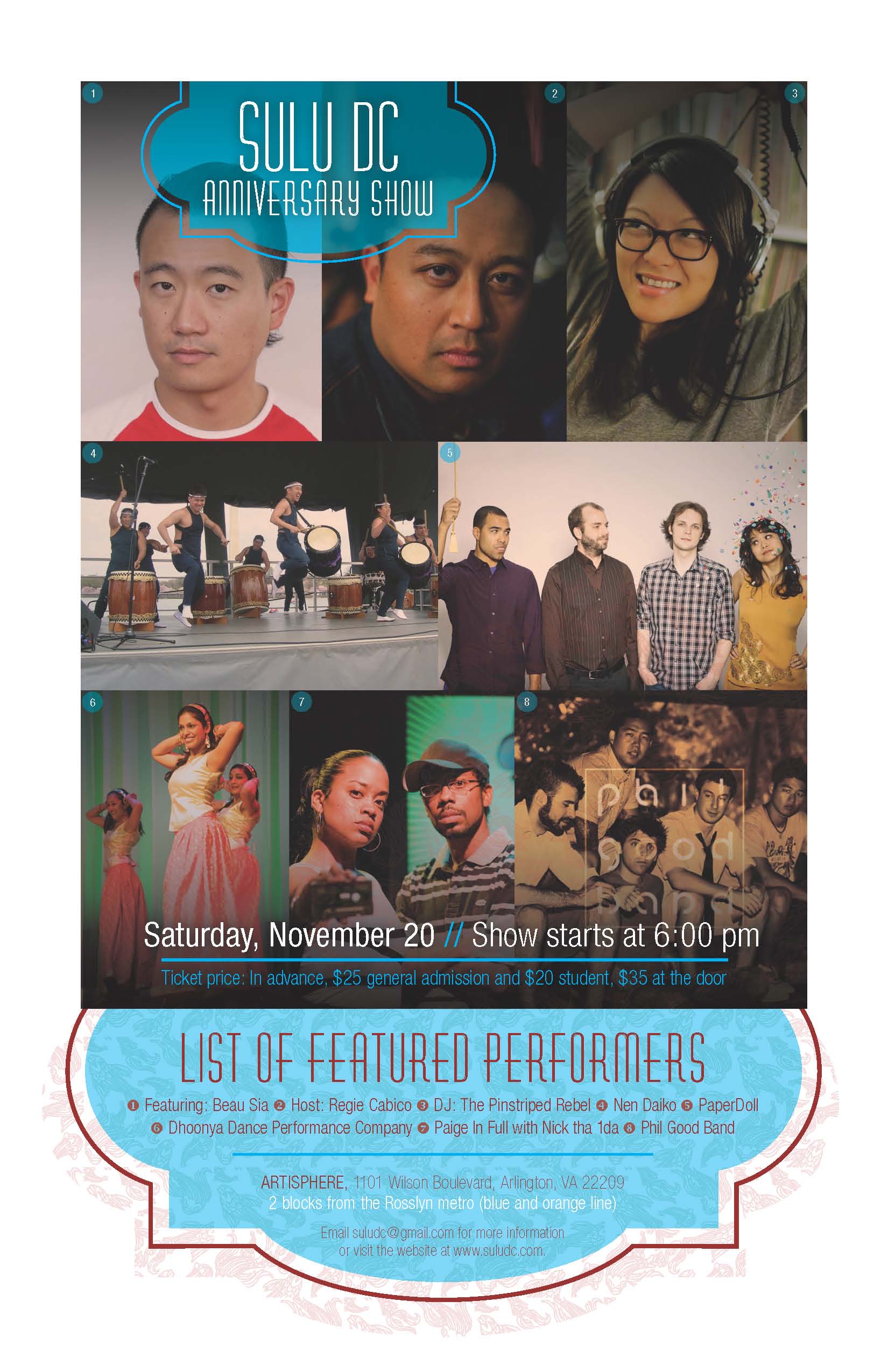
Sulu DC's 1st Anniversary Show (Click to enlarge the poster)

Our staff columnist, Simone, who is one of the organizers of the Sulu DC series, recently alerted us to the following very cool event:

On November 20th,  Sulu DC will be celebrating their first year with a special anniversary show hosted by Kundiman faculty member Regie Cabico and featuring—among other music, dance, and poetry acts—a special performance by celebrity spoken word artist Beau Sia.

Here’s the dish on the event, as described in their official press materials:

On November 20th, under the Artisphere’s Dome Theatre—a new and innovative arts space in Arlington, VA—locally and nationally renowned AAPI performers will ignite the stage. From Bollywood flares to Taiko drums, spoken word to modern dance, comedians to rock bands, the Anniversary Show will surely entertain and inspire. Hosted by Regie Cabico with music by DJ The Pinstriped Rebel, the Anniversary Show will pay tribute to leaders who have significantly contributed to the local and regional AAPI community through art and arts education, and celebrate Sulu DC’s accomplishments. Additionally, ticket proceeds will provide scholarships for 5–7 Sulu DC representatives to participate in the Asian Pacific Islander American (APIA) Spoken Word & Poetry Summit in Minneapolis in 2011.

The Sulu DC 1st Anniversary Show will take place on Saturday, November 20th at 6 pm, at ARTISPHERE, 1101 Wilson Blvd, Arlington, VA 22209 (1 block from the Rosslyn Metro station; parking validated on site).  Tickets, which can be purchased in advance by following these instructions (scroll down to the bottom of the page to find them), include the price of food and drink, and cost $25 for Advance Purchase Online (www.suludc.com) or $20 for Student with valid ID (or LiveGreen members).  Tickets will also be sold at the door for $35.

If you live in the DC area, we definitely encourage you to go and check out this landmark show.  As Simone has reminded us, tickets can sell out fast—so reserve yours soon.

Happy Birthday, Sulu DC, and congratulations on a successful first year!

Weekly Prompt: Old Shoes

Photo courtesy of BenettonTalk

I’ve adapted today’s prompt from Kim Addonizio and Dorianne Laux’s handbook The Poet’s Companion: A Guide to the Pleasures of Writing Poetry, which I use in my introductory poetry class to teach important craft concepts such as image, metaphor, and description.   It’s a fairly simple exercise–more of a starting point, really, from which to begin exploring deeper notions of presence, absence, and the manner in which memory “ghosts” poetic vision.  Feel free to respond to the prompt as is, or elaborate upon/disregard its restrictions as you see fit.

*  *  *

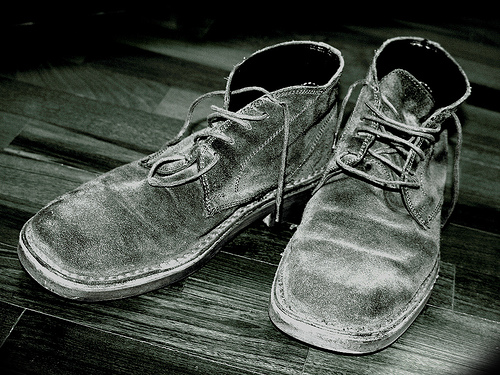
Think of a pair of old shoes.  Describe them in a way that will make the reader think of death, but do not refer to death explicitly in the poem.  If you wish, you may think of a specific pair of shoes that belongs to a specific person, but do not mention the person by name or indicate your relationship with them.

Review: CHA: AN ASIAN LITERARY JOURNAL, ISSUE 12

Cha: An Asian Literary Journal | Issue 12 | September 2010

Let’s dive straight in, examining three of the issue’s first poems and their wrestle with words and meanings.

Phill Provance’s interlace poem “St. Petersburg Has Many Churches,” is perhaps the most abstruse, though its diction remains commonplace. The poem’s charm lies not in its form but in its unself-conscious vernacular. Its colloquial voice, inconsistent in a way typical to modern speech, uses contractions here but not there, and lumbers along monosyllabic platforms (many its, thats, and ises). The loftiest word is “ellipticizing,” but this neologism, rather than conjugating the Latinate directly (“ellipsing”), invokes the urban by conjugating gym ellipticals as root. All this results in the naturalization of the poem’s anfractuous form, such that it flows with incidental ease. This is hard to achieve. Provance himself comments that the poem is designed to be accessible despite its layered meanings, which makes it an appropriate gateway poem to the journal. Yet: why is a poem about St. Petersburg, or his second poem remembering lost love, placed as the opening of an “Asian Literary Journal”? The third stanza of “St. Petersburg” describes a vaguely Zen mode of seeing, but the other poem has nothing culturally comparable. We’ll return to this.

Fiona Sze-Lorrain’s “A Talk With Mao Tze-tung,” though also colloquial, achieves a much steadier voice. This poem addresses the quondam Chairman’s mortal absence, because “you are nowhere / until a Swedish journalist recites your poetry / and wonders . . .” Living, and dead, and revived, Mao’s core vitality resides in his words and ideas, which become corporeal by revolutions. Thoughts march, words poison, books are buried. And along the way, vituperation must question itself: “why am I talking to you, dead man?” It seems language persists even when we don’t desire it, and since “history has no last word,” this poem ends in questions, and the talk with Mao must pause until an answer comes alive again.

Kim-An Lieberman’s two poems are among my favorites for their adroitness. “After Ten Years,” a loose-octameter poem, turns list into narrative. The “Because” reiteration chants and expiates, swelling to crescendo; the final line hits the kind of poetic denouement that evokes quiet “hm”s from audiences at readings. In “Harvest,” we begin in miniatures (“single beads, stray buttons, broken twigs”) and end in nature’s enormity. The sound of children’s jubilance masks the tone and the suffocating fish onshore, until the ending when the ominous “sudden true hand” comes forth unveiled. Lieberman distinguishes herself in poetic brevity with truncated phrases like “This is not to sing / a strange-eyed child, some oracular pure . . .” and doesn’t sacrifice clarity for linguistic decoration, or vice versa.

Continue reading “Review: CHA: AN ASIAN LITERARY JOURNAL, ISSUE 12”

LR News: The Blog Turns One!

A year ago today, we began our adventure here at the LR Blog with a little introductory post, in which we wrote:

Thank you for all of your support and patience [as] we continue to build LR piece by piece.  We look forward to carrying on more conversations with you in the weeks and months to come.

Today, that sentiment still remains true.  We are still so grateful to you, our readers, contributors, and supporters: to everyone who’s ever read an LR post or browsed our first issue, who’s ever submitted their work, who’s ever linked to or responded to our content,  Tweeted about us (or retweeted something we’ve posted), shared our posts on Facebook, patiently waited through one of our many deadline extensions or extended hiatuses, helped to spread the word about us, encouraged us with kind words, offered us advice, volunteered to assist us, given us a shoutout at a reading, agreed to pass out our materials alongside their own . . . thank you.  Without you, LR would not have been able to grow and thrive.  We have loved every bit of the conversations in which we’ve engaged with you during these last 12 months, and look forward to many more, and ever more interesting, dialogues with you in the months and years to come.

If you’d like to help us celebrate today, we’ll be Tweeting little flashbacks to posts from our first year throughout the day.  To follow along, look us up on Twitter (@LanternReview) and search for the hashtag #LRAnniversary.

Our humblest thanks, once again, for all of your continued encouragement and support.  Truly, we feel very, very blessed.

All the best,

Iris & Mia
LR Editorial Staff.

Weekly Prompt: Postcard Poems

Image from Kristine Uyeda's postcard poem, "Red Riding Hood" (published in Issue 1 of LR)

This week’s prompt was largely inspired by the beautiful Kundiman postcard poems that we had the privilege of publishing in our first issue. Writing postcard poems can be a lovely exercise in multiple respects. They are, by nature, short, which is a challenge in and of itself.  Furthermore, they are handwritten, and in some cases, hand-illustrated, too.  The detail and attention that drafting them requires can add a dimension of intimacy to the finished product.  Additionally, the fact that they are necessarily one-of-a-kind means that each postcard poem becomes a little one-off publication unto itself, and the card’s fragility and vulnerability to things like fingers and rain as it travels through the mail means that the piece that is received on the other end is always inscribed with a physical history of travel and transfer from hand-to-hand-to-hand.  The exchange of postcard poems , furthermore, can be an excellent way to build community, inviting collaboration, response, and the incorporation of poetry on a micro-scale into the everyday correspondence of those who participate.

Experienced poets may find it satisfying enough to challenge themselves with the tiny spatial confines of a postcard, but I have also included a variation below that I’ve tried in the community/classroom setting with some success.

Prompt:

Create or find a postcard whose subject interests you (non-geographically specific subjects tend to work quite well).  Decide upon a persona, or voice, and an addressee.  From what space, place, or position is that postcard being written?  How might this sense of positionality affect the speaker’s attitude towards the addressee, and thereby, the tone of his or her address? Write an epistolary poem on the back of the postcard, using the small rectangular writing space to shape your poem’s form.

Classroom Variation (“Wish You Were Here”):

Write a poem in the form of a postcard from an unusual location.  When I’ve done this exercise with small groups in the past, I’ve come prepared with a handful of blank notecards on which strange, mundane,  wacky , and/or otherwise non-geographical ‘locations’ have been pre-written (e.g. “The Bridge of George Washington’s Nose,” “The Back of the Refrigerator,” “The Library Dumpster,” “The Bee’s Knees,” “Inside Harry Potter’s Shoe,” “The Kitchen Table,” etc.).  On the back side of each card, I’ll draw or print a “postcard” template (complete with spaces for mailing address and stamp, should the students decide to mail off their completed pieces). After introducing the concept of epistolary poems to the students and giving them a few examples, I allow them to choose a “postcard” featuring a location that interests them.  The students are then given the chance to try writing a postcard poem on the back sides of their chosen cards.  For younger or more artistically-inclined groups, adding an illustration on the blank front side of the card can also be fun.

I’ve you’d like some great examples of postcard poems, check out the Kundiman poems “Red Riding Hood,” “Leaving Cortona,” and “Dear Disappearing,” from Issue 1 of Lantern Review, or read the poems from Kundiman’s 2007 postcard project that appeared in Shampoo 31. As always, if this exercise inspires a poem that you’d like to share, please do send it in!  We are still accepting submissions for Issue 2.

Sulu Spotlight: A Conversation with Taiyo Na

Above: A Taiyo Na scrapbook. Shown here are Regie Cabico, Taiyo Na, Taiyo Na’s youngest fan, Ishle Yi Park, Beau Sia and Taiyo Na fighting a giant yellow _____ .

As the Sulu Series came to an end on September 19, 2010 to a packed house at The Bowery Poetry Club in New York, I sat down with Sulu’s artistic director, Taiyo Na, to try to understand what five years of Asian and Pacific Islander performing arts meant to him and to our community. Below is a recap of our conversation, which I hope will inspire other cities (like The Sulu Series in New York, Sulu DC and Family Style in Philadelphia, among others) to gather and find platforms for our unique voices.

* * *

How did The Sulu Series begin in New York?

Two things really contributed to the formation of Sulu: Hurricane Katrina and the Boston APIA Spoken Word and Poetry Summit in 2005. After the Boston Summit there was a lot of good energy after a really great Summit. Regie [Cabico] felt like there needed to be a hub in New York City for Asian American artists. It was also because the Asian American Writers Workshop at the time felt like a less community-friendly space. Before that, the Asian American Writers Workshop was kind of that hub, so there was that factor. But then when Hurricane Katrina hit, it was like “Wow!” you know? It was a pivotal moment in the country of course, but also for a lot of us here because when they were covering Katrina we knew that there were a lot of Asian Americans down there in Louisiana and Mississippi and their stories weren’t being told and their needs weren’t being attended to. Sure, everybody was affected in that region. Everybody deserves the attention. But we wanted to do something in particular with the Asian American community to say, “You know, there’s a lot of Vietnamese folks there and they need help.” So we put together this benefit for those folks and the money went to the this group in Biloxi, Mississippi. That benefit kind of brought a lot of Asian American artists and organizations together and since then, we carried on Sulu. Regie was living in Williamsburg at the time and had a connection at Galapagos Arts Space in Williamsburg, Brooklyn. And they were like, “Hey, we have these Tuesday nights open, do you want to take it once a month?” and I’m like, “Okay.”

Was it just you and Regie [Cabico] then?

No, no, no, it was a bunch of us. [DJ] Boo was there. There were other artists, too. Terry Park and Chaz Koba, Hanalei . . . and a bunch of others. Even at the Katrina benefit, I became one of the main sort of cultural connectors—people who have the contacts with the artists and brought the artists together. It just kind of became this natural thing for me to do the monthly Sulu curating too after that. We did, I think, the thing at Galapagos for maybe a year or so and then, things weren’t really workin’ out there. The location was Williamsburg and not Manhattan and it was hard for folks to get to and you know, the vibe was different. So when the Bowery Poetry Club . . . I forgot what happened. But, we did an event here. We did like a special Sulu at the Bowery Poetry Club. It had to do with triple A.S. (Asian American Studies Conference). It was happening one year in New York and it went really well, so we were like, “Oh, well let’s just have it here.” Beau Sia has a good relationship with Bob Holman and it just all organically came about. Bowery Poetry Club became the new home and it’s been our gracious home ever since (for the last three years or so).

What do you see as the state of affairs for AAPI poetry, specifically in New York but in the rest of the country, also?

The APA poetry community here . . . I mean, I’m not per se an expert, but I think with Kundiman, it’s great. What they do here is just phenomenal. What Joseph Legaspi, Sarah Gambito and Ron Villanueva and Pat Rosal and all those folks have done to build that organization up to a retreat that can have like 20-some poets every year to help nurture their talents, to have a monthly reading series, is great. I think they’re a little bit more of an older crowd, more of like an academic crowd, but that’s fine, there’s that. But I think spoken word per se if we were to kind of split poetry up into those two camps—more academic poetry and then spoken word poetry—spoken word poetry is real healthy. It’s more mainstream, so there’s less of kind of the underground stuff, you know? It’s bigger and more popular than ever.

Continue reading “Sulu Spotlight: A Conversation with Taiyo Na”

LR News: November 2010 Update

Hello, all.

A couple of updates for the month of November:

Issue 2 Submissions Deadline: November 29th.

There’s just a few more weeks to send in your submissions for Issue 2!  Don’t forget to glance over our revised guidelines.  To get a feel of what we’re looking for, we suggest you take a read through Issue 1. You can find our submissions page here.

Where is Editors’ Picks? What happened to the Community Calendar?

Our Editors’ Picks column and the Community Calendar are on temporary hiatus, while we figure out a way to make maintaining them more sustainable for our two-woman editorial team.  LR is slowly growing,  and this fall has been a period of major transition for both of us, but we have been really grateful for our expanded blogging team, and are hopeful for the future.  Thank you so much for your continued support; we deeply appreciate your patience.

All the best for a lovely November,

Iris & Mia
LR Editorial Staff

Weekly Prompt: American Sentences

Allen Ginsberg, creator of the American Sentences form. Photo courtesy of Stanford University Special Collections.

A colleague recently introduced me to American Sentences, a poetic form developed by Allen Ginsberg in the mid-1980’s as a response to the haiku.  If haiku involved seventeen syllables down the page, he reasoned, American Sentences would be seventeen syllables across the page–an attempt to more accurately “Americanize” a form that had previously translated only roughly across the Pacific into the context of American poetry.

Like (rough) English approximations of the haiku, American Sentences work closely with concision of line and sharpness of detail.  Unlike its literary predecessor, however, it is compressed into a single line of poetry and included a reference to a month and year (or alternatively, a location) rather than a season.

Seattle-based poet John Olson observes:

[American Sentences are] extremely vivid & detail-oriented, a la the haiku. Emphasis is on the image, rather than rhetoric, or lyricism. Unlike the haiku, however, which is a highly bastardized form in English, they’re more suited to the American idiom & so allow a greater range of natural expression. They don’t have the aesthetic stiffness of the haiku as they are practiced in English.

A few examples by Ginsberg:

Nov 1991 N.Y.

Put my tie on in a taxi, short of breath, rushing to meditate

Tompkins Square Lower East Side N.Y.

Four skinheads stand in the streetlight rain chatting under an umbrella.

Prompt:

Write an American Sentence–or a series of American Sentences.  Focus not only on features characteristic of the haiku, like precision of detail and careful use of word, but also on the cadence and rhythm of “American vernacular,” however you understand it.

If you want, play with dialect and/or accent, challenging the boundaries of what constitutes the “American” Sentence and contextualizing the form to linguistic realities specific to your experience or understanding of the “englishes” of America.

For more information on the origin and possibilities of this form, check out Paul Nelson’s website on American Sentences, which includes an extensive archive of examples, interviews, and other helpful resources.

Writing Home | To Catch a Ghazal: Three Poems from Agha Shahid Ali’s THE HALF-INCH HIMALAYAS

THE HALF-INCH HIMALAYAS (1987, Wesleyan University Press)

Because of his status in American poetry as the prophet of the ghazal, it is especially interesting to look at Agha Shahid Ali’s earlier work. Moving backwards from the ghazal collection Call Me Ishmael Tonight (2003), through the long-lined, historically-alluding collections like The Country Without a Post Office, to his early poems, particularly The Half-Inch Himalayas (1987), the lines get shorter, the line breaks more jarring, the punctuation more irregular and the language more personal.

This poetics runs in tandem with speakers who have fallen out of time. “A Lost Memory of Delhi” places the speaker in a time where “[he is] not born” and he his watching his newly-wed parents: “[His] father / He is younger than [him]” and “[his] mother is a recent bride.”  Moreover, “They don’t they won’t // hear [him],” making it clear that that the speaker has come unpinned from time and has floated back to a memory that could not possibly be his and in which he is attempting to interrupt “the night of [his] being.” But this is true of the parents, too, even though they are bound in a more discreet time and space where they are able to interact with each other. The house that they enter “is always faded in photographs” and oil lamp that lights it that speaker “saw broken in the attic.” The past-perfect, in this case, is treated like the present.  In this space where the past coexists with the future and the future coexists with the past, it is the present that is absent, the present from which the speaker has fallen out into a non-presence, where he cannot be perceived.

Continue reading “Writing Home | To Catch a Ghazal: Three Poems from Agha Shahid Ali’s THE HALF-INCH HIMALAYAS”