Editors’ Picks: The LR Guide to AWP 2010

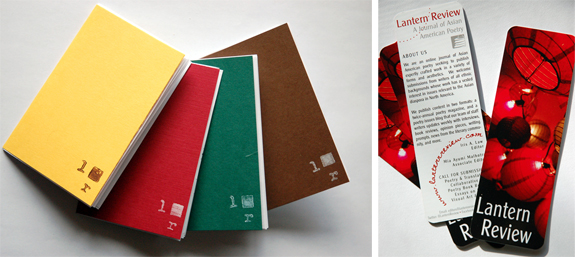
LR Goodies for AWP 2010: Bookmarks & Handmade Mini-Books

As we mentioned last week, the LR editors are gearing up for the 2010 AWP Conference with great excitement.  For those of you who will also be going, we thought we’d put together a list of panels and readings that we thought might be of special interest to readers and writers of Asian American poetry.  Come look for us, in particular, at Kundiman’s Thursday panel and Wednesday off-site reading (co-sponsored with Cave Canem).  If you check out the bookfair, you’ll also be able to find us (and our materials) at the Kundiman/Alice James Books table.

The Lantern Review Guide to AWP 2010
Recommended events of potential interest to LR readers

* * *

Wednesday

Off-Site Events:

7:00PM-10:00PM AHSAHTA / OMNIDAWN READING
Location: The Magnolia Hotel Ballroom, 17th & Stout (Only 3 blocks from the Colorado Convention Center.)
Cost: No charge for the event.
Please join Ahsahta Press and Omnidawn Publishing for a reading. The readers will be: Christopher Arigo, Susan Briante, Dan Beachy-Quick, Maxine Chernoff & Paul Hoover, Gillian Conoley, Ben Doller, Lisa Fishman, Noah Eli Gordon, Richard Greenfield, Janet Holmes, Hank Lazer, Laura Moriarty, Rusty Morrison, G.E. Patterson, Craig Santos Perez, Bin Ramke, Don Revell, Elizabeth Robinson, Heather Sellers, Heidi Lynn Staples, Michelle Taransky.

8:00PM-11:00PM Cave Canem/Kundiman Reading & Salon
Location: Mercury Cafe, 2199 California Street, Denver, CO 80205; (303) 294-9281
Cost: $3 suggested donation — to benefit Cave Canem & Kundiman (no one turned away for lack of funds)
Website: http://www.facebook.com/event.php?eid=474228325544&ref=ss
Join the Cave Canem & Kundiman Families for a Reading Featuring Toi Derricotte, Sarah Gambito, Cornelius Eady, Oliver de la Paz, Dawn Lundy Martin & Kazim Ali + a salon featuring Cave Canem and Kundiman fellows & family (bring a poem to share!)  Emceed by Ching-In Chen & Tara Betts.

Thursday

9 AM to 10:15 AM

R117. Decolonial Poetics: Womanist, Indigenous, and Queer Poets of Color on the Art of Decolonization. (Ahimsa Timoteo Bodhrán, ku’ualoha ho’omanawanui, Lorenzo Herrera y Lozano, Susan Deer Cloud, Ching-In Chen, Lisa Suhair Majaj)

R121. The Online MFA: An Innovative Alternative to the Resident and Low-Resident MFA. (Lex Williford, Daniel Chacón, Sasha Pimentel Chacón, José de Piérola)

10:30 AM to 11:45 AM

R124. Bollywood, Bullets, and Beyond: The Poetry of South Asian America. (Summi Kaipa, Pireeni Sundaralingam, Ravi Shankar, Bhanu Kapil, Subhashini Kaligotla, Monica Ferrell)

Noon to 1:15 PM

R148. Kundiman: Love Songs and Leaps of Faith. (Vikas Menon, Jennifer Chang, Matthew Olzmann, Sarah Gambito, Rick Barot, R.A. Villanueva)
Continue reading “Editors’ Picks: The LR Guide to AWP 2010”

A Conversation With Mong-Lan

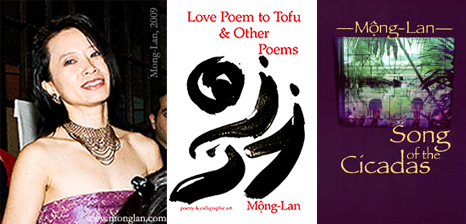
Mong-Lan and two of her book covers.

Mong-Lan is a Vietnamese-born American poet, writer, painter, photographer, and Argentine tango dancer and teacher.  Mong-Lan’s first book of poems, Song of the Cicadas, won the 2000 Juniper Prize from UMASS Press and the 2002 Great Lakes Colleges Association’s New Writers Awards for Poetry.  Her other books of poetry include Why is the Edge Always Windy?; Tango, Tangoing: Poems & Art, the bilingual Spanish / English edition, Tango, Tangueando: Poemas & Dibujos and Love Poem to Tofu and Other Poems (chapbook). A Wallace E. Stegner Fellow in poetry for two years at Stanford University and a Fulbright Fellow in Vietnam, Mong-Lan received her Master of Fine Arts from the University of Arizona.  Her poetry has been frequently anthologized, having been included in Best American Poetry, The Pushcart Book of Poetry: Best Poems from 30 Years of the Pushcart Prize; Asian American Poetry —The Next Generation, and has appeared in leading American literary journals. Her paintings and photographs have been exhibited at the Capitol House in Washington D.C.,  for six months at the Dallas Museum of Art, at the Museum of Fine Arts in Houston, in galleries in the San Francisco Bay Area, and in public exhibitions in Tokyo, Bali, Bangkok, Buenos Aires and Seoul. Based in Buenos Aires, Mong-Lan travels frequently.  Visit: www.monglan.com

LR: You are both a visual artist and a poet, and both of these art forms have a strong presence in your books.  How have your sensibilities as a visual artist have influenced your poetry’s aesthetic?  Did you come to one through the other?  At what point did the two interests begin to intersect?

ML: My sensibilities as a visual artist have influenced greatly my poetry’s aesthetic.  The open field of the page is important to me, just as the blank canvas or white sheet of paper is to the visual artist.  When writing poetry, I think in spatial terms, not just linearly.  So, in this way, I concern myself with the placement of words on the page, using the way words bounce off each other, the connotation of words next to each other, above, below, to the right and left, and diagonal. In Tango, Tangoing, my latest book, you can read certain poems not only left to right, but down one column, then down another column.

I didn’t come to one art through the other.  A visual artist since childhood, I showed my artworks in Houston and then in San Francisco, where I flowered and came to mature as a visual artist in the very liberal atmosphere there.  At the same time, I was writing since high school, scribbling in journals my feelings, emotions, narratives, stories and things that I couldn’t depict visually in paintings.

Both poetry and the visual arts are twin sisters, and it’s easy for me to shift from one to the other.  I find that these arts complement each other.  And, so, there in San Francisco in the 90’s, I found myself as a poet as well as a visual artist, giving readings with other Vietnamese-American writers/poets.

LR: When you are putting together a collection of poems that will include visual artwork — how do you view the art in relationship to the text?  Do you see the art as illustrations of your poems? As a kind of visual poetry in and of itself?

ML: In my first two books, Song of the Cicadas and Why is the Edge Always Windy?, the text is primary, and the visuals secondary.  The artwork in both books were used more as appetizers and section dividers.  In Song of the Cicadas, I included pen and ink drawings that I drew when I was in Vietnam, the same time I was writing the book itself.  It just happened, naturally and synchronistically like that.

Because many people commented on my artwork in both books, I decided to include more of them in my next books.  In the chapbook, Love Poem to Tofu & Other Poems, and in Tango, Tangoing: Poems & Art, the artworks are very integral to the books, indeed [they] complement the text a great deal, although the texts can stand by themselves.  There are many more drawings/paintings in these latter two books—they’re more like entrees and not just appetizers.

The artworks in my books can stand by themselves; thus, they are not mere illustrations. Yet, they do illuminate the text and add another dimension to it.  Yes, I would consider my artworks a kind of visual poetry in and of itself.

Continue reading “A Conversation With Mong-Lan”

Weekly Prompt: Dramatic Monologues (remembering Ai)

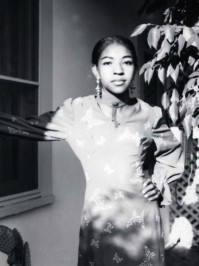
Ai in 1972

In honor of the poet Ai, who recently passed away, this week’s prompt focuses on the dramatic monologue — a technique for which she was famous.

Born Florence Anthony, she adopted the name “Ai” after discovering that she had been conceived through an affair between her mother and a Japanese man that she (Ai) had never met.  The Poetry Foundation’s bio on her describes her particular sensibilities well:

Ai is a poet noted for her uncompromising poetic vision and bleak dramatic monologues which give voice to marginalized, often poor and abused speakers . . . She has said that her given name reflects a “scandalous affair my mother had with a Japanese man she met at a streetcar stop” and has no wish to be identified “for all eternity” with a man she never knew. Ai’s awareness of her own mixed race heritage—she self-identifies as Japanese, Choctaw-Chickasaw, Black, Irish, Southern Cheyenne, and Comanche—as well as her strong feminist bent shape her poetry, which is often brutal and direct in its subject matter.

Ai’s poetry practically vibrates with the force of its imagery.  Her lyrics leap from the page and inhabit the personas she takes on without apology.  One of the things for which she was noted was her ability to enter the voices of those at the margins of society and infuse them with dignity and magnetic strength.

To illustrate, here is the opening to her poem Salomé:

I scissor the stem of the red carnation
and set it in a bowl of water.
It floats the way your head would,
if I cut it off.
But what if I tore you apart
for those afternoons
when I was fifteen
and so like a bird of paradise
slaughtered for its feathers.
Even my name suggested wings,
wicker cages, flight.
Come, sit on my lap, you said.
I felt as if I had flown there;
I was weightless.
You were forty and married.
That she was my mother never mattered.
She was a door that opened onto me.
The three of us blended into a kind of somnolence
and musk, the musk of Sundays. Sweat and sweetness.
That dried plum and licorice taste
always back of my tongue
and your tongue against my teeth,
then touching mine. How many times?—
I counted, but could never remember.
What stands out for me in these opening lines is the unforgettable boldness and clarity of its images: the scissored red carnation becomes a severed head, her description  of dried plum and licorice give a sickening viscerality to the complexity of the speaker’s relationship to the “you” — he is at once abuser and lover, taker of innocence, and seductor, the wielder of an invisible tyranny in which the mother is also implicated: at the end of the poem, when a ghostly sword slices through the speaker’s throat, the mother’s dress is like that “of a grenadier,” and we are made to see how her kiss becomes an act of terrible violence disguised as tenderness.

In honor of Ai’s life, work, and legacy, here’s this week’s prompt.

Prompt: Write a poem in the form of a dramatic monologue in the voice of a single speaker who is not yourself.  Optionally, if you do not wish to write a traditional persona poem, you may imagine the speaker’s voice as a loose projection of your own.

LR News: April Updates

The cruelest month?  We hope not — at least, not this year!  Lots of exciting things are going on this April for LR.  Here’s a quick rundown of our news for the month:

National Poetry Month Prompt Contest (Deadline EXTENDED)

We’ve had a modest response to our National Poetry Month Prompt Contest so far, but we’d like to give more people the chance to enter, so we’re extending the deadline to Thursday, April 8th. The same rules will apply (we’ll announce the third runner-up on Friday the 9th).  Please do take the time to submit a prompt if you haven’t already done so — it only takes five minutes, and if you win, you’ll not only have the opportunity to see your prompt featured on our blog, but will also receive a signed copy of Monica Youn’s Ignatz.

Lantern Review at AWP 2010

As we mentioned in last month’s update, the LR editors (Mia and Iris) will both be in Denver for the Association of Writers & Writing Programs conference next week, April 7-10.  If you’re going to be there, please come look us up around the Kundiman/Alice James Book table, or at one of the Kundiman events, and say hello!  We’ve been working really hard on some nifty promotional materials to distribute, so if you visit Kundiman’s table, you’ll also be able to pick up  bookmark and one of a series of handmade mini-books we’ve produced to featuring selections of our blog content.  Of you follow us on Twitter or are a Facebook fan, you’ve already seen some sneak peeks.  We’ll post photos of the finished products and a list of Asian American poetry events taking place at AWP on the blog early next week. (We’ll also do an event coverage post about AWP after we return from Denver).

April Community Calendar Updated

We’ve updated our Community Calendar page for the month of April.  As always, please continue to let us know about events we haven’t included.  We’ll continue to add to and update the list as the month goes on.

End of Reading Period for Issue 1

Our submissions period for Issue 1 will close on April 15th (tax day!) If you haven’t yet sent in your work, we want to see it!  You can find our submissions guidelines here. (Many thanks to those who have already submitted).

* * *

Happy Passover or Holy Week to those of you who are celebrating!

Best,

Iris & Mia
Lantern Review Editorial Board

LR News: Submissions Form Fixed!

Just a quick update to let you know that our amazing Tech Consultant, Brandon, has fixed the issue with our submission form.  You should now be able to submit visual art as usual.  (We’d appreciate it if you could please use the form to submit rather than emailing us, as it allows us to keep better track of your submission and to respond to you sooner).

Submissions will continue to be open until April 15th (Visit our submissions guidelines here).

Thank you so much to those of you who helped by pointing out the problem!  Please do let us know immediately should you ever run into further technical issues with our site or form in the future.

LR-News: Image Submission Errors

It’s recently come to our attention that our online form has been giving people errors when they’ve tried to submit visual art.  Please accept our apologies for the inconvenience as we continue to investigate the issue.

If you’ve also received an error that has prevented you from submitting work to us, please do drop us a line in the comments to let us know!

In the meantime, if you would like to submit visual art (and only if you are submitting visual art – poets and writers of essays & reviews must still go through the online form; we will not be able to read your submission otherwise), you may bypass the form by emailing your images to editors [at] gmail (dot) com. Please include the following information in the body of your email:

Prefix (Ms/Mr/Mrs/Dr):

First Name:

Last Name:

Contact telephone:

Mailing Address:

Artist Name(s) [if different from the contact name; translators should include the name of the original poet here; this is where authors of collaborative works should indicate co-authors]:

2-3 Sentence Artist Bio(s):

Titles of pieces included:

Is this a simultaneous submission? (Yes/No):

Submission Categories [Poetry(Individual Artist) / Poetry (Collaborative) / Translation / Essay / Book Review / Visual Art / Community Voices]:

Additional Info:

Statement of Originality (type your full name beneath the statement to indicate your agreement):

“I certify that the work being submitted has not been previously published in any format (neither print nor electronic), and that it is either:

  1. My own original creation (defined as a poem, prose piece, visual artwork, or new translation created solely by the artist or artists indicated above), OR
  2. (If submitting to the community profiles category) An original creation of the group that I represent.”

Thank you so much for your patience.  Our apologies once again for your trouble.

Best,

The LR Editorial Board

Contact Information

Prefix*
First Name*
Last Name*
Contact Email*
Phone (###-###-####)
Address 1*
Address 2
City*
State or Province (if US or Canada)*
Postal Code*
Country*

Manuscript Information

Artist Name(s)*
Artist Bio(s)*
Title #1*
Title #2
Title #3
Title #4
Title #5
Is this a simultaneous submission?*
Yes No
Submission Categories (Select all that apply. See Category Descriptions):*
Poetry (Individual Artist)
Poetry (Collaborative)
Translation
Essay
Book Review
Visual Art
Community Voices

Additional Information

File Upload (Click for file size/type requirements)*

Statement of Originality*

I certify that the work being submitted has not been previously published in any format (neither print nor electronic), and that it is either:

  1. My own original creation (defined as a poem, prose piece, visual artwork, or new translation created solely by the artist or artists indicated above), OR
  2. (If submitting to the community profiles category) An original creation of the group that I represent.
Agree Disagree

Weekly Prompt: Poem-Objects

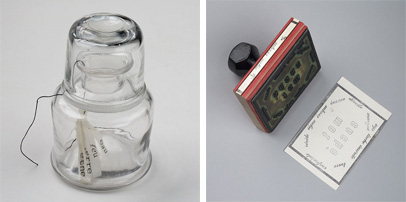
Untitled and "Mot Cache" by Theresa Hak Kyung Cha

This week’s prompt is inspired by some of the visual poetry work done by Theresa Hak Kyung Cha (1951 — 1982), a Korean American artist and poet who experimented with film, mixed media, intertext, and live performance to push her audience’s experience of the written word in radical directions.  Cha lived an incredibly productive, but tragically brief life: at the age of 31, she was murdered by a stranger in New York City.  Her much-studied book of hybrid poetry, prose, and image, Dictee, was published a week before her death.

One of the things that interests me most about Cha’s body of work is her experimentation with the book as object.  On many occasions (as in the two pieces pictured above), she made use of objects other than the standard book format in order to demonstrate a kind of poetic.  The forms and physical textures of the (often handmade) media with which she presented words in these pieces creates a process-oriented experience for the observer, in which we see and can feel the labor required to produce each piece of text.  The text itself, too, has a physical quality to it.   In the “untitled” piece above, it dangles almost precariously on wire, trapped halfway in a glass jar (the words read “water,” “fire,” “earth” . . . and something which I can’t quite make out . . . in French).  We sense the microcosmic nature of language — it becomes a flimsy, yet beautiful item that constitutes our world.

Prompt: Create a poem designed to be presented as a 3-d object.

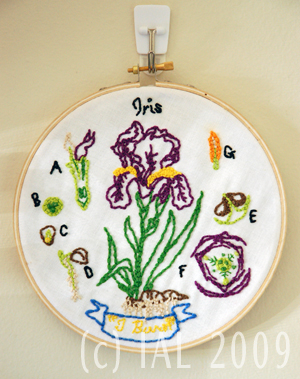
"Self-Portrait"

The piece I’m sharing with you here is actually a project I created for a contemporary poetry class last year: we were supposed to create an archaism, and I decided to use the technique of embroidery, along with nineteenth century / early twentieth century botanical diagrams and mottos from the language of flowers, to reflect on the idea of a curated representation of self (the work, obviously, is a pun on my name; the antique language of flowers handbook that I used indicated that the Iris used to convey the message “I Burn [for you]”).  This, when combined with the sexuality of the plant’s anatomical structures (a flower is a plant’s reproductive organ), and the traditionally gender-bound craft of decorative embroidery, I hope — forms a reflection on gender, artifice, craft, and time.

To see more works by Cha, visit the BAM/PFA online archive.

As always, please do feel free to share your experiments on our Flickr pool. Happy Weekend! (Don’t forget to think about an entry for our prompt contest!)

Announcing Our 2010 National Poetry Month Prompt Contest

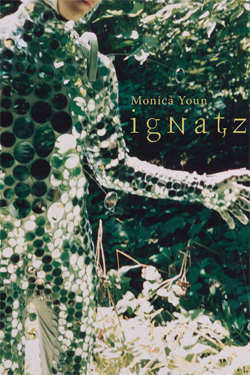
Special Prize: A Signed Copy of Monica Youn's IGNATZ.

National Poetry Month is coming up in April, and in order to mark it, the LR blog is going to be hosting our first ever Prompt Contest, made possible by the generous sponsorship of Four Way Books.  Do you think our Weekly Prompts could use some spicing up?  Do you have a favorite writing exercise that you’d like to share?  Here’s your chance to have your ideas featured in our weekly content, or even — if you turn out to be the one lucky person whose prompt we like best — to win a signed copy of Monica Youn’s new collection Ignatz!

Here’s how it will work:

1) Leave a comment on this post that includes the text of your prompt.  Entries must be posted by 11:59PM EST on Thursday, April 1st April 8th. Comments on this post will close after that time. Please leave some form of basic contact information in your comment (even if it’s just a link to the contact page on your web site), so that we can get in touch with you if you win.

2) During the first full week of April, we’ll be choosing the four prompts that we like best.  The winner and all three runners up will have their entries featured as Weekly Prompts on the LR Blog during the four Fridays from April 9th – 30th.  In addition, the winner will also receive a special prize that has been graciously offered  by Four Way Books: a signed copy of Monica Youn’s Ignatz. We will announce the runners up and winner week by week starting with the third runner-up and culminating with the winner, so keep on checking back in April to see if your entry has been featured.

3) A few ground rules: You may only enter once. Please submit only poetry prompts.  Keep all prompts appropriate: anything of a bigoted, demeaning, or nasty nature will not be considered; we’d also appreciate it if you could please try to keep your prompts somewhat PG in nature, as when choosing prompts we always try to look for flexible exercises which can be adapted for classroom use with either adults or kids.

That’s it!  Go forth and prompt-ify; we look forward to reading your entries!  And while you’re at it, please do check out Ignatz on Four Way’s site.  Many thanks to Editor Martha Rhodes, to Monica Youn, and to Four Way for their generosity.  Be on the lookout for our review of the collection next month.

Weekly Prompt: Poems that Play with Shape

During the past week or so, we’ve been looking at poems and aspects of presenting poems on the page which take into account (2-D) visual space and make room for illustration and elements of painting, drawing, collage, etc.  This Friday, our prompt asks you to reexamine a form which many of us may remember being introduced to in grade school: the concrete poem.

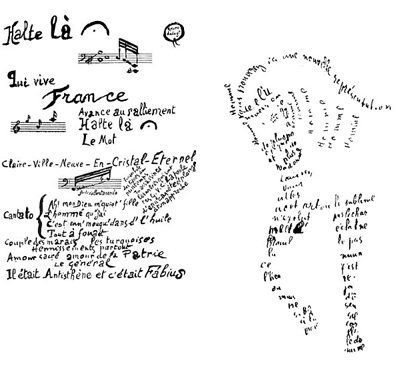
Examples of Calligrams by Guillaume Apollinaire

Concrete poetry,” according the Poetry Foundation’s glossary, is “Verse that emphasizes nonlinguistic elements in its meaning, such as a typeface that creates a visual image of the topic.”  Far from being limited to poems whose words take on the outline of the object they are describing, concrete poetry can encompass everything from a playing with the sizes and spacing of text on the page to certain kinds of full-on “visual poetry,” which are more akin to collage or painting in their methods of arrangement words. The challenge, of course, is how to integrate the visual into a poem in a way that is satisfyingly beautiful (or jarring, depending on the desired effect) and yet feels organic and further enhances the complexity of the reader’s interaction with it.

Prompt: Write a  poem takes into account shape and visual space on the flat plane of the page.

Some suggestions:

1) Compose a calligram, or poem in which the shape of the words enacts or take on the visual form of some object as a kind of complex illustration.  (See examples of Guillaume Apollinare’s famous calligrams at the top of this post).

2) Create a poem that experiments with unusual typographical arrangements to emphasize its meaning.   The Poetry Foundation also has a couple of neat visual poems that play with the shapes of letters: here, and here.

3) Write a poem on a piece of paper (or other flat surface) that is not a standard vertical letter-sized or notebook-sized sheet, using the shape of the surface to guide your form.  For example, a long piece of ribbon, or the back of a circular coaster.  I’ve found that this exercise (which I’ve borrowed from a former teacher of mine, Bruce Snider) becomes especially interesting if one uses a writing surface that already has words on it and allows those words to seamlessly flow into the resulting poem.  (Examples of poets who’ve used a similar technique include A.R. Ammons, who wrote “Sphere” on ticker tape, and D.A. Powell, who wrote one of his books with his notebook turned sideways).

4) Write a poem that engages with the use of negative space in an existing piece of text or image (for example, a poem written in the margins of a newspaper, between the lines of a letter, or in the background spaces of a photograph or advertisement).

We realize that this week’s prompt is a little different, in that your response may or may not be easy to share in comment form.  In light of this, we’ve created a Flickr pool where you can upload photos of your responses to our prompts if you’d like to share them [if you don’t feel comfortable uploading photos of whole poems, feel free to crop creatively or blur out portions of the text].  Here’s how to do it:

1) Follow this link to get to our pool.

2) Click “Join this Group.” (Sign into Yahoo/Flickr if you need to do so, or create an account).

3) Confirm that you want to “Join this Group.”

4) Upload the image or video you want to your stream.  In the description, mention the prompt you’re responding to (if you like you can include the text, too, but that’s not necessary). We suggest that you tag your poem for ease of navigation as the pool grows (for example, I’ve tagged the concrete poem I uploaded with “concrete poem”), but that’s also optional.

5) Choose “Groups >> Your Groups”

6) Select the group “Lantern Review — Weekly Prompt Responses”

7) Click “Add something.”  Follow the instructions to add your photo to the pool.  That’s it!

We hope that you’ll share some of what you’ve written with us; we’d love to see how your experiments turn out.  If we get enough responses, we may even feature some of them on the blog in upcoming weeks.

Editors’ Picks: A Roundup of Asian American Poetry Broadsides

The presenting of poetry in beautifully laid-out flat prints — often accompanied with artwork or produced using the letterpress process — is a time-honored tradition.  The broadside emphasizes the way that a poem navigates visual space and draws out the reader’s sensual experience of a poem beyond the metaphorical or imagined and into the realm of physical touch, color, line, and shape.  The production of broadsides also provides opportunities for collaborative conversation between poets and the people who deal intimately with the physical production and setting of their work: book artists/printers, painters and illustrators.  In recent years (especially with the advent of internet technology), the broadside also has taken on new importance as a means by which to make poetry more familiar, more affordable, and more culturally accessible to the public.  The Poetry Foundation’s free downloadable “refrigerator” broadsides and the Broadsided project — which publishes printable electronic broadsides and encourages their free distribution in public places — are two examples of projects that seek to expand the scope of  the dialogues taking place around poetry while still maintaining a value for stunning visual presentation.  I’m particularly drawn to the idea of both kinds of broadsides — those which, by their small-scale production (often by hand), ensure that the poems printed on them will continue to be treasured as objects of quality and great cultural importance, and those which, by their widespread availability, ensure that poetry can continue to grow outside of itself, to evoke new conversations in unusual places so that the consumption of beautiful art need not be reserved for those with money.

Here is a short roundup of some broadsides I found that feature Asian American poetry:

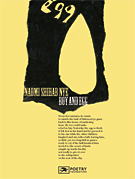
Naomi Shihab Nye – “Boy and Egg”
[One of a series of free printables from the Poetry Foundation’s web site]

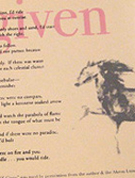
Li-Young Lee – “Every Circle Wider”
[Available from the Poetry Center of Chicago]

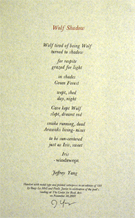
Jeffrey Yang – “Wolf Shadow”
[Available from the Center for Book Arts in NYC]

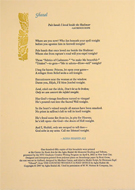
Agha Shahid Ali – “Ghazal”
[Available from the Center for Book Arts in NYC]

Oliver de la Paz – “If Given” and “Fury”
[Available on his web site]

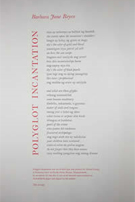
Barbara Jane Reyes – “Polyglot Incantation”
[Available from Zoland Poetry]

Has your poetry ever been made into a broadside?  Do you create broadsides?  We’d love to hear from you!  Please leave a comment to tell us about your experiences.