Weekly Prompt: Superstitions

This week’s prompt is based on a surrealist exercise.  I tried leading a version of it this past spring at the Center for the Homeless, where I was participating in a writing group, and it was fascinating to hear the kind of responses that the topic of superstition evoked.  Everyone had a story to tell: of Irish grandmothers who threw salt over their shoulders, fathers who insisted that if their son did not wear a particular “lucky” jersey, their favorite team would lose, fears of opening umbrellas indoors and ruminations on the subject of black cats (What happens to people who own black cats? They must cross their pets’ paths all the time). Whether or not one would identify oneself as superstitious, there is something attractive about the imaginative possibilities evoked by unusual relationships of cause and effect.  If I sleep with my notes under my pillow the night before a test, will the information really seep into my brain?  There’s something intriguing about the idea of translating physical symbols — marks on the page — into knowledge which might be acquired through touch, mediated by the permeable state(s) of sleep and dreaming.  Superstitions celebrate the strange and fantastic, the unusual and the inexplicable and the ways that we ground our narratives of encounter with them within the contexts of ritual and belief.  Where do superstitions come from?  What happens when we develop new ones?  (For example, “If you sneeze when the wind is blowing South, you’ll generate a tornado somewhere” or, “Don’t eat pretzels on a Sunday; you might come down with the measles”). The following exercise asks you to engage with the question of where and how we come to associate actions with otherwise mysterious consequences.

Prompt: Come up with a new superstition and elaborate upon it in a poem; or, develop a series of new superstitions — and use them to write a list poem.

As an interesting example of a poem based on a made-up superstition, we’ll leave you with this excerpt from Marin Sorescu’s poem, “Superstition“:

My cat washes
with her left paw,
there will be another war.
For I have observed
that whenever she washes
with her left paw
international tension grows
considerably.
How can she possibly keep her eye
on all the five continents?
Could it be
that in her pupils
that Pythia now resides
who has the power
to predict
the whole of history
without a full-stop or comma?
[Visit the Poetry Foundation web site to read the rest of Sorescu’s poem.]

LR News: June 2010 Updates

It’s June, and we at LR are rounding off our seventh month of blogging.  Here are some new things that you can expect to see from us this month:

Issue 1 Is Coming!

We are very pleased to announce that Issue 1 of our magazine will be released — if all goes as planned — on Monday, June 14th.  We have been working very hard on curating and laying out the more than 30 poems and visual art pieces that we’ve selected, and can’t wait to show you the final product.  Check back on the blog for sneak peeks and other updates in the next week or so.

June 2010 Community Calendar is Live

We’ve updated the Community Calendar for the month of June, and as usual, we welcome any corrections and additions that you may have for us.  This month, we’re pleased to be able to feature some cool Asian American literary events happening in Minneapolis, in addition to the cities we regularly cover:  June 7th is the registration deadline for the amazing-sounding Lao American Writers’ Conference that will be held at the LOFT Literary Center this August; the LOFT will also be holding an event featuring graphic novelist Gene Yang on June 18th. We look forward to continuing to cover events at the LOFT in future months.

June LR Blog Features: Barbara Jane Reyes, Indivisible, and More

During the past three months, we’ve mostly focused on themed posts, but this summer we’ll be returning to our regular blog content.  Some things to anticipate: our staff writer Ada Yee recently had the opportunity to conduct an interview with Barbara Jane Reyes — look out for her remarks about poetry, history, and community on the blog tomorrow; we also had the pleasure of meeting some of the editors of Indivisible (the first-ever anthology of South Asian American poetry) back in April, and are excited to announce that during the next couple of months, our staff writer Supriya Misra will be running a couple of feature posts on their work.  We’ll also be continuing with weekly prompts and with our editorial columns Friends & Neighbors and Editors’ Picks.

Thank you so much, once again, for all you’ve done in responding to our posts and spreading the word about us.  We are so thrilled to finally be rounding the home stretch into Issue 1 — and are ever grateful for your support.

Sincerely,

Iris & Mia
LR Editorial Staff

Process Profile: Neil Aitken Discusses “I Dream My Father on the Shore”

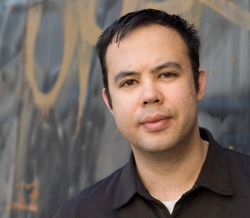
Neil Aitken
Neil Aitken

Neil Tangaroa Aitken is the author of The Lost Country of Sight which won the 2007 Philip Levine Prize for Poetry and was published by Anhinga Press in 2008. His work has been nominated for the Pushcart Prize three times and has appeared in Crab Orchard Review, The Drunken Boat, Ninth Letter, Poetry Southeast, Sou’wester, and elsewhere.
Born in Vancouver, British Columbia, Neil grew up in Saudi Arabia, Taiwan, and the western parts of the United States and Canada. He holds a B.S. in Computer Science from Brigham Young University, an M.F.A. in Creative Writing from the University of California – Riverside, and is currently working on a Ph.D. in Literature & Creative Writing at the University of Southern California.

In our Process Profiles series, young contemporary Asian American poets discuss their craft, focusing on their process for a single poem from inception to publication. Here, Neil discusses “I Dream My Father on the Shore,” the final poem in his collection The Lost Country of Sight.

* * *

It was the summer of 2006 and I was attending my second Kundiman retreat at the University of Virginia. We’d been challenged to write a ghazal and when I sat down to work on the poem, I found myself linking the form’s tradition of exploring the ties between beauty and loss with my own memories of my father’s loss of his father. Although I’d written about that experience many years before, I felt that a different poem might reside in the space created by time and distance, and the way that dreams and memories alter our understanding of the past. I set out to craft something that would carry a certain dreamlike lushness, while reflecting the constant turn and return of the form.

The poem went through several drafts and gradually I realized that perhaps the ghazal was not the actual form it needed to take. I ended up trimming out most of the repetition, but tried to keep a sense of the original form present through sound and rhythm – like a ghost or an afterimage of the ghazal. Switching to free-verse opened up more possibilities, allowing the line-breaks to do more work and permitting me to extend images, phrases, and conceits over larger spaces in the poem.

As I worked on the poem, I found myself reflecting on my own relationship with my father and how he had once told me that he would not live a long life; that he would likely die young from one of the many health conditions he endured. His sense of mortality and the way he had offered the news to me before I first left for college all those years ago seemed in some way to echo a line from Wendell Berry’s “The Country of Marriage” and so I eventually included that line as the poem’s epigraph. By the time the poem was published by Sou’wester in late 2007, my father had passed away from an aggressive form of ALS and the closing lines of the poem suddenly became much more than dream or metaphor. When I assembled the version of the manuscript that became The Lost Country of Sight, I knew that this would be the poem to complete the book, and that those last images would be the ones I wanted to linger on when the final page was turned.

Below is the final version of “I Dream My Father on the Shore,” as it appears in Neil’s collection:

I Dream My Father on the Shore

What I am learning to give you is my death.
~ Wendell Berry

Outside, beneath the light of late October’s candled sky
the weave of ash and maple burns.  We stand silent on the graveled shore.
My father lifts his father’s ashes from its urn, a strangely heavy thing,
he seems to say, his arms swaying, then casting out into the long dark
as if to throw a line, while we wait for some sound, a wave,
whatever marks the distance between a father and a son.

And when night comes, it comes without a tread, without a word.

The stars flickering in their endless retreat, more distant and sure

than before, do nothing while the shadows continue to fill the trees
with their cast-off clothes.  The harvest is long past, the apples
have fallen to the orchard floors.  Even my father turning to go
is almost lost to the reeds already in his path, his figure no more
than a pattern of light – a memory of a road that winds
through the darkness to our waiting ride home.

Process Profile: R.A. Villanueva Discusses “In Memory of Xiong Huang”

R. A. Villanueva

R.A. Villanueva lives in Brooklyn. Recent writing has appeared or is forthcoming in journals such as Indiana Review, Virginia Quarterly Review, AGNI, McSweeney’s Internet Tendency, DIAGRAM, The Literary Review, and The Collagist. A Kundiman fellow, he is currently a Language Lecturer at New York University.

In our Process Profiles series, young contemporary Asian American poets discuss their craft, focusing on their process for a single poem from inception to publication. Here, R.A. Villanueva discusses his poem “In Memory of Xiong Huang,” which first appeared in the Winter 2009 Issue of Virginia Quarterly Review.

* * *

Ars Poetica with Illuminated Bodies

1.

At the heart of Michael Paterniti’s “The Most Dangerous Beauty” is a description of the Topographische Anatomie des Menschen that is, by turns, lyrical and grotesque. Truth be told, Paterniti’s cluster of renderings and pivots is less a “description” of Eduard Pernkopf’s life work and more a walking tour of his Anschluss abbatoir-made-studio.

Paterniti offers an unfurling litany, a conjuring of Pernkopf’s Anatomy that reckons with how “page by page” these medical illustrations grow increasingly “stunning, bombastic, surreal.” He affirms that it is “bone-and-muscle evidence, the animal reality of who we are beneath the skin” before doubling-back: “what if a number of these paintings have been signed with swastikas, what then?…Do the secrets revealed in the Book count less than the secrets kept by it?”

What starts as an unveiling of an atlas of the body thus becomes for us a visceral interrogation of how we reconcile our ethics with our want to see, our need to know. By essay’s close, beauty is everywhere cut with casualty and grief.

Continue reading “Process Profile: R.A. Villanueva Discusses “In Memory of Xiong Huang””

Process Profile: Ching-In Chen Discusses “Olivewood Cemetery: a haibun of Riverside, California”

Ching In Chen (photo by Sarah Grant)

Ching-In Chen is the author of The Heart’s Traffic, a novel in verse.  She hearts street food, the zuihitsu & other “hijacked forms” and gets lost easily. Daughter of Chinese immigrants, she is a Kundiman, Macondo and Lambda Fellow. A community organizer, she has worked in the Asian American communities of San Francisco, Oakland, Riverside and Boston.  She is the co-editor of The Revolution Starts at Home: Confronting Intimate Violence Within Activist Communities, forthcoming from South End Press in 2011. She can be found online at www.chinginchen.com.

In our Process Profiles series, young contemporary Asian American poets discuss their craft, focusing on their process for a single poem from inception to publication. Here, Ching-In discusses her poem “Olivewood Cemetery: a haibun of Riverside, California” which originally appeared in the 10.2 issue of Diagram.

* * *

This poem began at a Ching Ming (grave-cleaning) ceremony for the Riverside Chinese who hadn’t been sent back to China and didn’t have descendants to take care of them.  I felt a chill — of history, ghosts, untold stories, communal energy — as we gathered to read the names of the dead.  The list also consisted of death causes, occupations, ages.  As the roll call continued on in my head, what became clear was how much I did not know about these people.  At the time, I was teaching sections for Creative Writing and we had to read Rick Moody’s “Boys,” in which he repeats the same sentence over and over, adding in different meanings by adding layers over the sentence.  This made sense to me for my Chinatown dead.

Continue reading “Process Profile: Ching-In Chen Discusses “Olivewood Cemetery: a haibun of Riverside, California””

Process Profile: Tamiko Beyer Discusses “In this metropolis”

Tamiko Beyer

Tamiko Beyer’s poetry has appeared in The Collagist, Sonora Review, OCHO, and elsewhere. She serves as the poetry editor of Drunken Boat and has led writing workshops for homeless LGBT youth with the New York Writers Coalition. She is a founding member of Agent 409: a queer, multi-racial writing collective, and is a Kundiman Fellow. She is pursing her M.F.A at Washington University in St. Louis. Find her online at wonderinghome.com and blogging at kenyonreview.org.

In our Process Profiles series, young contemporary Asian American poets discuss their craft, focusing on their process for a single poem from inception to publication.  Here, Tamiko discusses her poem “In this metropolis,” which first appeared in The Progressive in February 2008.

* * *

I think it was April. I was writing a poem a day and running out of ideas. I turned to Charles Bernstein’s Experiments and chose the first one: a “homolinguistic translation,” a translation from English to English. I chose to “translate” Ilya Kaminsky’s poem “A Toast” because I was obsessed with his book Dancing in Odessa and wanted to live in one of his poems for a while.

The result: a whole new realm of diction. And a tone of contemplative urgency from Kaminsky’s poem that infused itself into my own, even when I eventually let go of the constraint.

Themes of home and community (ones I return to again and again) also echo from the source poem. Early on, it became clear to me that I was writing about gentrification. Living in a dynamically shifting part of Brooklyn, I am hyper-aware that what I do and how I spend my money isn’t just about me. There are ramifications across the neighborhood. I would have never set out to write a poem quite like this in tone and voice, but the exercise brought out a persona that gave me a strange kind of permission to push hard into this reality.

Continue reading “Process Profile: Tamiko Beyer Discusses “In this metropolis””

Poetry In History: Writing About the I-Hotel

Scene from the 1977 I-Hotel Eviction (Credit: SF Chronicle)

In celebration of APIA Heritage Month, we’ll be running a special Poetry in History series once a week in lieu of our Friday prompts.  For each post in the series, we’ll highlight an important period in Asian American history and  conclude with an idea that we hope will provoke you to respond. Today’s post is about the fraught history of the International Hotel in San Francisco’s Manilatown.

In 1977, San Francisco’s Manilatown community suffered a huge blow with the final eviction of the mostly Filipino American residents from the International Hotel (or I-Hotel).  This followed  almost a decade’s worth of protest and community struggle in the hopes that the building, which had housed many Filipino immigrants throughout the years, would not become yet another victim of the city’s gentrification projects.   For years after the final residents were removed, the building — and later, the site — stood empty, the hole a yawning reminder of what had been lost.  One of the major voices speaking out against the fall of Hotel belonged to the poet, musician, and activist Al Robles. The I-Hotel was a recurring theme that wove throughout his work and took on breath, shape, and life through his poetry.  Robles’ nephew wrote the following on the recent anniversary of his death:

“In the I-Hotel he [Robles] traveled up the stairs and the doors opened to those small rooms; the smell of rice and adobo and fish was there; the face of the manong was there—he knew the face—it was the face of his father and mother and ninong and ninang. He sat across from the manongs and in their faces he saw the motherland, in their hearts and minds he journeyed and tasted what he described the “thick adobo tales of their lives”. Those elderly men were alive and in Uncle Al’s poetry they became young again.” (Tony Robles, “Still Hanging onto the Carabao’s Tail”)

The I-Hotel was eventually rebuilt into a community center.  The new building, opened in 2005, houses the Manilatown Heritage Foundation and is a hub for political and arts events.  Al Robles passed away in 2009, but his legacy continues to be celebrated.  Other poets have since followed in Robles’ footsteps, writing about their relationship to the city of San Francisco, and to the “ground zero” that was the I-Hotel site.  One such poet is Barbara Jane Reyes, whose poem dedicated to Robles is forthcoming in the first issue of Lantern Review. In her book Poeta en San Francisco, Reyes touches on the shape of this wound, invoking the evicted bodies whose physical rootlessness signifies a history fraught with forced erasures and displacements.  In her poem “calle de sección ocho, casas de abuelos y de abuelas,” her speaker invites us to enter the hole in the ground where the hotel once stood

“the unused hole in the ground located at the corner of kearney and
jackson across from celluloid god’s patina café may one day contain
supportive tenant services and artifacts of blue men’s billy clubs in the
meantime just gawk at it and take polaroids don’t hold your breath
few descend into the hole it’s been 30 years”

Manilatown itself becomes a ghost with a cavity in place of the organ that was the I-Hotel, which by the end of the poem is revealed to be a type of inverted sanctuary, inhabited by “ghosts and discarded things,” made remarkable for its absence — its existence etched out in the negativity of its space, the way that it tunnels into the earth rather than rises up from it.

Continue reading “Poetry In History: Writing About the I-Hotel”

Process Profile: Janine Joseph Discusses “Postcard”

Janine Joseph

Janine Joseph is a Ph.D. student in literature and creative writing at the University of Houston. Her poems have appeared in Third Coast, Spoon River Poetry Review, and Calabash, among other journals. A Kundiman fellow, she is a recent recipient of a Brazos Bookstore/Academy of American Poets prize and a Paul & Daisy Soros Fellowship for New Americans. She holds degrees from UC Riverside and the Creative Writing Program at NYU where she taught with the Starworks Foundation and Community~Word Project. She currently teaches with Writers in the Schools and serves as a poetry editor for Gulf Coast. Born in the Philippines, she was once a child actress.

In our Process Profiles series, young contemporary Asian American poets discuss their craft, focusing on their process for a single poem from inception to publication.  Here, Janine discusses her poem “Postcard,” which originally appeared in the Fall/Winter 2008 themed issue (“Making Tracks: Escape or Journey”) of Nimrod International Journal.

* * *

I first started thinking about “Postcard” when an old friend came to visit for a weekend in May of 2006. While waiting for our chicken kabob sandwiches at Mr. Falafel, I told Lucy, who had studied poetry with me in college, that I couldn’t get the image of a “soup kitchen—but not a soup kitchen” out of my head. I was fresh out of my first year in the MFA program at NYU and, with a stainless steel cup in my hand, I talked about Tupperware and a childhood memory. Lucy, being Lucy, listened and then told me what I had was a poem. What kind of a poem, I didn’t know. After lunch, we took the subway into the city and walked.

After an evening of writing in September, I brought “Soup Kitchen” into workshop. On the page, the poem was a perfectly square thing that could be cut, glued, and made to fit on a postcard. It included mysterious and humiliating phrases like “jalousie of life” in the last line. (Also, it used the color mauve.) What on earth did I mean by writing “jalousie of life”? I’m not even going to pretend I knew. What was clear by the end of my fifteen minutes of sitting silently during discussion was that the poem, according to my notes, was one part “lovely” and one part “this could go.” In class, I drew a line dividing one movement from the other.

Continue reading “Process Profile: Janine Joseph Discusses “Postcard””

Process Profile: Jason Koo Discusses “Man on Extremely Small Island”

Jason Koo

Jason Koo is the author of Man on Extremely Small Island, winner of the 2008 De Novo Poetry Prize (C&R Press, 2009) and a Finalist for the National Poetry Series, the Kathryn A. Morton Prize and the Ohio State University Press/The Journal Award in Poetry. He was born in New York City and grew up in Cleveland, Ohio. He earned his BA in English from Yale, his MFA in creative writing from the University of Houston, and his PhD in English and creative writing from the University of Missouri-Columbia. The winner of fellowships from the National Endowment for the Arts and the Vermont Studio Center, he has published his poetry and prose in numerous journals, including The Yale Review, North American Review and The Missouri Review. He teaches at NYU and Lehman College and serves as Poetry Editor of Low Rent. He lives in Brooklyn with his cat, Django.

In our Process Profiles series, young contemporary Asian American poets discuss their craft, focusing on their process for a single poem from inception to publication.  Here, Jason discusses the eponymous poem from his first collection, Man on Extremely Small Island.

* * *

I originally wrote this poem for a workshop on ekphrastic poetry led by Scott Cairns at the University of Missouri-Columbia. I’d written the first poem for that workshop on a Hopper painting, which was predictable—so many poets have written poems about Hopper paintings. I myself had already written three poems about Hopper paintings.

So I went to Acorn Books, one of the used bookstores near campus, and started browsing through art books, looking for something I hadn’t seen before. I wanted to get away from the high tradition of Western art and do something unorthodox. After looking through shelves and shelves of books, I stumbled across The Collected Cartoons of Mordillo, a book of black and white cartoon drawings by this Argentine artist I’d never heard of before. His cartoons were hilarious, featuring little men and women with huge noses in various island and urban situations; they read like parables about modern life and relationships. I was drawn by his ability to tell whole narratives in just a few frames with no words. His sensibility spoke to me immediately.

Continue reading “Process Profile: Jason Koo Discusses “Man on Extremely Small Island””

Poetry in History: The Angel Island Poems

In celebration of APIA Heritage Month, we’ll be running a special Poetry in History series once a week in lieu of our Friday prompts.  For each post in the series, we’ll highlight poetry written during and/or about an important period in Asian American history and will conclude with some ideas that we hope will provoke you to responding to these poems in your own work.  Today’s post centers around the wall poems written by Chinese immigrants who were detained in the Angel Island Immigration Station.

Angel Island Wall Carvings

This Saturday (May 8th) marks the celebration of the 100th anniversary of the Angel Island Immigration Station.  Often called the “Ellis Island of the West,” Angel Island served as the site for processing as many as 175,000 Chinese immigrants from 1910-1940.  During the era of Chinese Exclusion, immigration interviews were more like interrogations.  American officials often asked impossibly detailed questions that were supposedly designed to root out anyone who was attempting to enter the country illegally, but in reality, the questions served mainly to intimidate immigrants and pit family members’ accounts against one another.  Conditions in the barracks were very much like prison, too.  Detainees were separated by gender and locked up in crowded barracks while they awaited questioning, for weeks or months — sometimes, for years — at a time.

To pass the time, many immigrants wrote or carved poems into the soft wood of the barrack walls.  Discovered in 1970 by a park ranger, 135 poems from the men’s barracks survive and have been preserved (the women’s barracks, unfortunately, were destroyed in a fire long before the 70’s).  The poems vary in theme, form, and in level of polish, and serve as a testimony to the experience of detention, chronicling everything from hope to anger to loneliness, to a sense of adventure.  In 1999, Genny Lim, Him Mark Lai, and Judy Yang compiled and translated a selection of the poems and included them in their book Island, which juxtaposes the poems with historical accounts and documents that tell the immigration station’s story.

Here are a two examples of the translated wall poems (courtesy the Ancestors of the Americas’ online excerpt of Island):

The sea-scape resembles lichen twisting
and turning for a thousand li.’
There is no shore to land and it is
difficult to walk.
With a gentle breeze I arrived at the city
thinking all would be so.
At ease, how was one to know he was to
live in a wooden building?

* * *

Because my house had bare walls, I began
rushing all about.
The waves are happy, laughing “Ha-ha!”
When I arrived on Island, I heard I was
forbidden to land.
I could do nothing but frown and feel angry at heaven.

These poems are powerful to me because of the way that one sees violent tension struggling to the surface beneath the almost lyrical quality of the poets’ surroundings.  In a way, they encapsulate the experience of being trapped into a cell in the middle of an island so lush that it’s now a designated a nature preserve.  The beauty of the world available outside the window belies, even betrays, the ugliness of the speakers’ experiences inside the detention center.  They are cut off, denied passage, hemmed in by human constructions (both physical and psychological). That the poems are also so different in tone also indicates the complex diversity of attitudes amongst the detainees: while the speaker of the first poem causes us to reenact the shock of his experience by dropping us smack into the cell after describing the “gentle breeze” of his hopes upon arrival, the speaker of the second poem draws us into a world in which everything — even the waves — are in collusion with the authorities.  The tone of the second poem explodes with angry energy, while the first is ironic and almost dryly detached at its end.

Continue reading “Poetry in History: The Angel Island Poems”