Process Profile: Vikas K. Menon Discusses “Othertongue”

Vikas K. Menon

Vikas K. Menon is a poet and playwright whose poems have appeared or are forthcoming in publications such as burntdistrict, diode, and The Literary Review, among others.  His poetry manuscript godflesh was a finalist for the 2010 Kinereth Gensler Award and a semifinalist for the Beatrice Hawley award, both from Alice James Books.   His poetry has been featured in Indivisible:  An Anthology of South Asian American Poetry and is forthcoming in The HarperCollins Book of English Poetry by Indians.  He is a board member of Kundiman, the first organization of its kind dedicated to supporting Asian-American poetry and is the Resident Playwright of Ruffled Feathers Theater company. 

For APIA Heritage Month 2012, we are revisiting our Process Profile series, in which contemporary Asian American poets discuss their craft, focusing on their process for a single poem from inception to publication. This year, we’ve asked several Lantern Review contributors to discuss their process for composing a poem that we’ve published. In this installment, Vikas K. Menon discusses his poem “Othertongue,” which appeared in Issue 3 of Lantern Review.

*  *  *

My writing process is both fitful and fickle:  at the beginning of a writing session, I tend to move quickly among drafts to see which pieces pull me into further play.  This method has allowed me to elude the blocks that used to plague my writing life.  “Other Tongue” started in quick sketches; in this case, with a freewrite about my struggles with my parents’ ancestral tongue, Malayalam.  Malayalam is a Dravidian language that is outside of the Indo-European family of languages, and it is primarily spoken in the South Indian state of Kerala.  While I can comprehend Malayalam when it is spoken colloquially, I am otherwise illiterate in the language.  Since it was the language of intimacy used by my elders during my childhood, I am ashamed by my inability to speak it fluently.  But I can still revel in its aural pleasures and rolling cadences, its stark contrasts with English.  So I began writing into the texture of it, exploring the strangeness of its syllables in my mouth.  At the same time, I was working on a separate poem that explored my mother’s English, which is heavily inflected by Malayalam.  Finally, I realized that the two poems were linked by their exploration of the difficulties of articulation.  Despite that theme, paradoxically, the poem works quite well at readings: there is initial laughter at my mother’s malapropism that quickly turns to silent discomfort.  I like that sudden turn, something the poet and performer Regie Cabico does beautifully.
LR News: Happy APIA Heritage Month!

It’s Asian/Pacific Islander American Heritage month, which means that it’s once again time to celebrate on the Lantern Review Blog. This May, we’ll be picking up with two special series that we’ve run in previous years, in addition to posting our regular fare of interviews, columns, and reviews. Here’s a glance at what you can expect to see:

Process Profiles Series

Just as we’ve done in past Mays, we’ve asked several of our contributors to write short guest posts for us in which they reflect upon their processes for writing a poem of theirs that we’ve published.  This has always been one of our favorite series to run, and we hope that you’ll enjoy this year’s installments equally as much as those from years past.  A new Process Profile will be posted each week (usually on a Wednesday), every week, for the duration of May.

Curated Prompts

We had a lot of fun getting to work with our guest prompt-writers last May, so we’re thrilled to be able to continue our Curated Prompts series—in which we post writing exercises contributed by respected writers and teachers of Asian American poetry in lieu of our regular Friday Prompts—during this year’s APIA Heritage Month.  This year’s lineup begins with Karen An-hwei Lee, whose exuberant, weather-inspired exercise will appear on the blog this Friday, the 4th.

Issue 5 Reading Period to Open Mid-Month

We’ve been waiting to re-open our reading period, because we have a very special announcement to make about our next issue. All will be revealed in mid-May, when we will officially open our doors to submissions for Issue 5.

The Poetry Celebration Continues

We’re particularly lucky, in a sense, that Poetry Month and APIA Heritage Month are back to back, because it means that we have the opportunity to celebrate Asian American poetry for two months straight!  In addition to our May series, we will also be keeping April’s Digital Broadsides up on the blog, and will continue to post Pocket Broadsides on Tumblr. We hope that you’ll continue to share these projects far and wide as our celebration of Asian American poetry continues.

Many thanks, and a very happy May to you.

Iris & Mia

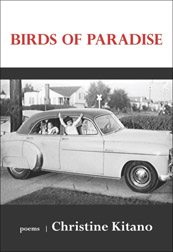
Review: Christine Kitano’s BIRDS OF PARADISE

Birds of Paradise by Christine Kitano | Lynx House Press 2011 | $15.95


“Plain, gray, and though I didn’t / know Latin then, still could guess / what inornatus might mean,” writes Kitano in the closing poem of her collection, referring here to the baeolophus inornatus, or plain titmouse, that flies into her family’s kitchen and is promptly killed. She demands a funeral, identifying with the poor bird:

Plain gray Christine, also known as
the plain daughter, Filia inornata
of the Kitano family. Plain gray
above, paler gray below; crest gray.

The irony of the plain, filial bird emerges when placed in conversation with the title poem of the collection, “Birds of Paradise,” which refers not to birds but to a plantfrom South Africa that looks like the birds. The title also calls to my mind the “false birds of paradise” plant from the Hawaiian islands that looks like the South African plant. I mention all this in order to call attention to the layers of resemblance and recognition—crucial themes to this book of poems. In the title poem, our plain filia inornata cups the bird of paradise plant in her hand, pretending “to be an African queen, the stunning orange / bird my companion, or Sleeping Beauty, / the flower’s sharp stigma a poisoned spindle.” A child of Japanese and Korean immigrants, her marginality and desires push her to imagine a still greater and still more exotic paradise than the one to whichher family has arrived.

Continue reading “Review: Christine Kitano’s BIRDS OF PARADISE”

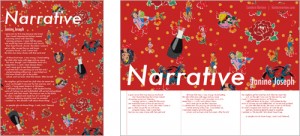
Digital Broadsides: Janine Joseph’s “Narrative,” Designed by Bethany Hana Fong

Download the "Narrative" Broadsides
"Narrative" (Click to visit the download page)

This week’s Digital Broadside, which features Janine Joseph’s “Narrative” from LR Issue 4, was designed by Bethany Hana Fong, an SF-Bay-Area-based artist and designer whose black and white portraits of her grandfather appeared in Issue 2. We love the way that the quirky, collage-like nature of Bethany’s design echoes the fractured whimsy of the narrative tellings in Janine’s poem. We also like the effect that designing each version (printable and wallpaper) in a different orientation had on the possibilities for reading the poem itself.  While the print version preserves the original (vertical) arrangement of stanzas, the wallpaper version floats them side-by-side into a matrix-like grid, so that the stanzas can be read in juxtaposition, as well as linearly. Both versions of Bethany’s beautiful design can be downloaded over at our “Digital Broadsides” page.

We hope that you’ve enjoyed our Digital Broadside series this April. And as National Poetry Month draws to a close, we hope you’ll consider telling us about what you did with the broadsides that you downloaded. Did you hang a copy somewhere unusual? Did your new wallpaper or cubicle decoration lead to any interesting conversations?  Did having a poem on your desktop or physical wall inspire you in your own writing life in some way? We’d love to hear your stories— leave us a comment, post a note on our Facebook Wall, or Tweet us to share!

LR News: 2nd Exchanged Pocket Broadside on Tumblr

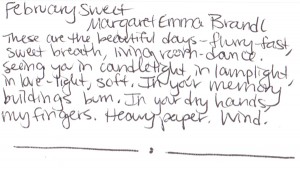
PB-EX_2
No. 2 (Margaret Emma Brandl) - Exchanged for a Pocket Broadside at AWP 2012

The second of the pieces that was given to us in exchange for Pocket Broadsides at AWP—a short poem by Margaret Emma Brandl—is now posted on Tumblr! Click here to read “February Sweet.”

To see all of the Pocket Broadsides that have been posted on Tumblr thus far, visit the project’s main page at pocketbroadsides.tumblr.com. To read each new piece as soon as it is posted, follow us on Tumblr, or subscribe to the RSS feed.

Review: Michelle Naka Pierce’s CONTINUOUS FRIEZE BORDERING RED

CONTINUOUS FRIEZE BORDERING RED

Continuous Frieze Bordering Red by Michelle Naka Pierce | Fordham University Press 2012 | $19.00

Michelle Naka Pierce’s Continuous Frieze Bordering Red is made up of five lines spanning sixty-eight pages. Read the first line of the book all the way through, and then the second line, and so on. Pierce conceived of this project during the study of Mark Rothko’s Seagram murals at the Tate Modern in London. She writes a room with sixty-eight sides. We are surrounded.

Pierce chooses to begin with an epigraph by Rothko, the ending of which leads us not toward the grandiose, but toward the uncomfortably intimate: “However you paint the larger picture, you are in it.”

At first I wanted to see Pierce’s text installed, each page depicting a scene in a sequence of discrete panels. I wanted to see the breadth of such a room—I wanted to be inside of it. Then I realized—I’m in it. Pierce is in it. This sixty-eight-sided room is the spectral polygon we inhabit. Continue reading “Review: Michelle Naka Pierce’s CONTINUOUS FRIEZE BORDERING RED”

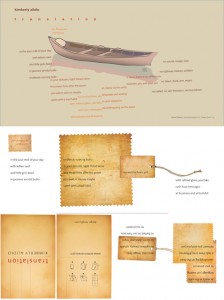
Digital Broadsides: Kimberly Alidio’s “translation,” Designed by Kenji C. Liu

Download the "translation" Broadsides
"translation" (Click to visit the download page)

This week’s digital broadside download is actually two designs in one. Designer Kenji C. Liu has created two separate visions for Kimberly Alidio’s poem “translation” (from LR issue 2): not only has he designed a beautiful desktop wallpaper, featuring an image of a boat, but he’s also conceived of the printable version in such a way that it can be cut and folded into a miniature chapbook. Kenji (who’s a poet and past LR contributor himself, in addition to being a crackerjack graphic designer) had this to say about his decision to create a printable that requires an element of DIY:

The reason I decided to make an “interactive” broadside is I’m interested in making bookmaking as accessible as possible. The broadside is a great tradition that makes writing easier to distribute. I just wanted to take it one step further and demystify the book. This mini-chapbook is more in the DIY “zine” tradition but is also inspired by pocket poetry and “poems for all“. It is extremely easy to make, reproduce, and distribute. I hope others will use this format for their own poems, and leave them everywhere.

In the spirit of making it even easier to spread the poetry love, we’ve created a video tutorial demonstrating how to turn it into a book:

Both of Kenji’s beautiful designs can be downloaded at our “Digital Broadsides” page. Where will you leave a copy of your “translation” mini-chapbook?  As always, we would love to see a photo or hear a story.  Tag us on Facebook or on Twitter, leave a video response on YouTube, or send us an email at editors [at] lanternreview (dot) com.

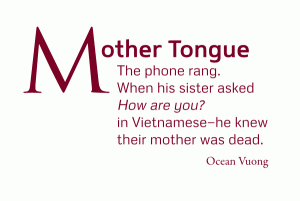
LR News: Ocean Vuong’s Pocket Broadside on Tumblr

Pocket Broadside #4 - Ocean Vuong

Issue 1 contributor Ocean Vuong‘s Pocket Broadside, a miniature poem called “Mother Tongue,” is now on Tumblr!

To read all of the Pocket Broadsides that have gone up so far, please visit the project’s main page at pocketbroadsides.tumblr.com.

As always, we’d be grateful if you helped us spread the word by following, reblogging, tweeting, or Faceb00k-sharing.

Panax Ginseng: Barbarize the Rules (pt. 2 of 2)

Panax Ginseng is a monthly column by Henry W. Leung exploring the transgressions of linguistic and geographic borders in Asian American literature, especially those which result in hybrid genres, forms, vernaculars, and visions. The column title suggests the congenital borrowings of the English language, deriving from the Greek panax, meaning “all-heal,” and the Cantonese jansam, meaning “man-root.” The troubling image of one’s roots as a panacea will inform the column’s readings of new texts.

*

Bad Hong Kong Movie Subtitles

*

When I spoke at the “Speaking in Tongues” panel for AWP in Chicago, organized by Sandra M. Yee, I found myself taking issue with the panel’s description:

In this panel of rising young artists, each writing inside two or more languages and/or cultures, we examine how we see ourselves pushing against literary and cultural traditions. How do we challenge our assimilation into the English language? To whom do we owe our allegiance as writers? Who is our audience? Whether code-switching or speaking in ancestral tongues, how do we act as representatives of our cultures? And in an increasingly globalized society, how do we embrace or shun these roles?

In my talk, I questioned the idea of writing “inside” two or more languages and cultures, because that “inside” presupposes an “outside.” Prepositions in English—at, on, into, through, from—tend to be physical or directional. In the grammar of other languages, such as in Chinese, prepositions are largely nonexistent or based on context. But in English, to write “inside” a tradition is to situate that activity within space, and to define a space is to define its boundaries.Since, despite my complaints, I am still bound to the grammatical strictures of English,) I would prefer to say that rather than writing “inside” languages and traditions, we write “across” them. One example I provided in my talk was a recently published short story by playwright and author Rosebud Ben-Oni, to whom my talk was dedicated. I wish to comment more at length about the story here.

Continue reading “Panax Ginseng: Barbarize the Rules (pt. 2 of 2)”

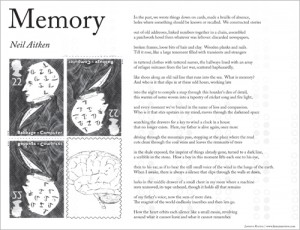
Digital Broadsides: Neil Aitken’s “Memory,” Designed by Melissa R. Sipin

Download the "Memory" Broadside
"Memory" (Click to visit the download page)

This week’s digital broadside features Neil Aitken‘s poem “Memory” (from Issue 4), and was designed by Melissa R. Sipin, who’s a poet, a cofounder of TAYO, and a past LR contributor herself.  We asked Melissa if she would share some of her thoughts about her choice of Neil’s poem and how that led her design process, and here is what she had to say:

I was led to design Neil Aitken’s “Memory” because of the poem’s vivid play on the concept of memory and its correlation with “the sum of mere data.” It awoke something nostalgic in me, and I was organically drawn to these lovely lines: “What is memory? / And who is it that slips in at these odd hours … / Who is it that stirs upstairs in my mind … / Here, my father is alive again, once more…”

In the same breath, after learning the intent of Aitken’s poem and its connection with Charles Babbage, I researched the life of Babbage and began to design the poem organically. Designing tends to be a visceral experience for me, and as a result, the visual themes of absence and gradient holes took hold. I hope I designed a broadside that is pleasurable to Aitken and the heart of the poem.

I think it’s safe to say that Melissa has successfully captured at least our hearts with her gorgeously illustrated design!

Melissa’s lovely interpretation of “Memory” is available in two forms—as a printable .pdf, and as a  desktop wallpaper—and can be downloaded at our “Digital Broadsides” page. We hope that you’ll download both—and that, especially if you hang or leave a copy of the printed version in a public space, you’ll share a picture  with us (on Facebook, on Twitter, or by email), and tell us about any stories that might be generated when others encounter it.