A couple of readings, 2 ASL Open Mic’s, some book release events, a panel, plays — this week’s roundup is really quite a mix. Of particular interest: poet Michael Leong at Dartmouth, Diane DiPrima’s Inaugural Address as SF Poet Laureate, and the BECOMING AMERICANS Anthology reading in NYC. And of course, don’t forget to tune in to President Obama’s first State of the Union Address tonight at 9 PM EST.
Here at LR, we value community as a space for growth and artistic exploration. The mentorship that we receive when we work with older writers, and the camaraderie we experience when working with our peers can both be particularly important in encouraging us to push forward with our strengths and in challenging us to reach for new heights in our work. Writing and creating alongside other members of the Asian American community can also be a incredibly transformative experience: on the individual level, it can help us to wrestle with our personal senses of vision and identity, while on a larger scale, it can help us to mobilize ourselves as a community. There are many opportunities to participate in community writing workshops that happen throughout the year, but in this post we’d like to focus on three whose deadlines are coming up in the next few months.
Poet Luisa Igloria, whom we interviewed back in November, has recently brought a new call for submissions to our attention.
According to an announcement on the Ning page of Old Dominion University’s MFA program, the brand new electronic journal Barely South Review is looking for: “work of engaging and exceptional quality that excites and invites varied perspectives, from emerging as well as established writers in the genres of fiction, poetry and nonfiction” to feature in its debut issue.
Submissions will be accepted until February 15th, via email. Click here and scroll down to read the full instructions and guidelines.
Lots of readings going on this week. Of note: Patrick Rosal at Cornell College; Monica Ferrell and SULU series in support of Haiti (respectively) at Bowery in NYC, Lawson Inada in Oregon, performace poetry workshop at Stanford University’s Listen to the Silence Conference. Also worth checking out: KSW/Kaya’s SF Thomassons Performance Tour.
“In Memoriam . . .” is not a typical memorial poem. It begins with a rush of chaotic terror:
“honey people murder mercy U.S.A.
the milkland turn to monsters teach
to kill to violate pull down destroy
the weakly freedom growing fruit
from being born
America”
Jordan’s syntax is like machine gun fire. Sharp “d” and “t” sounds perforate a matrix of associative fragments that superimpose images of fertility (“honey,” “milkland,” “growing fruit”) with images of destruction (“murder . . . / to kill to violate pull down destroy / the weekly freedom”). The tumbling momentum of her words propels us violently into the word “America,” which—rather than acting as a barrier against the tide of violence—becomes a springboard that births not liberty, but further atrocities. Despite the line breaks that set it off, “America” serves sonically and thematically as sprung breath — a launching pad, rather than an arrival. In stanza two, we are met with with an even longer list of brutalities:
“tomorrow yesterday rip rape
exacerbate despoil disfigure
crazy running threat the
deadly thrall
appall belief dispel
the wildlife burn the breast
the onward tongue
the outward hand
deform the normal rainy
riot sunshine shelter wreck
of darkness derogate
delimit blank
explode deprive
assassinate and batten up
like bullets fatten up
the raving greed . . .”
Rape, assassination, and fire “fatten up / the raving greed.” Participating in acts of violence becomes a kind of gluttonous exercise, in which the consumption of brutality turns into a “raving greed” for more. It is not until we reach the all-caps “STOP” at the end of Section I that the motion of the poem is disrupted.
The violence does abate momentarily at the beginning of part II, lapsing into a quieter contemplative image of sleep and shells, and the speaker’s voice begins to emerge more cleanly in longer, more lyrical and more conventionally “grammatical” stretches of syntax. But we are simultaneously made aware that the privileges of this sleep are reserved for an unnamed “they” who claim their “regulated place” by means of “some universal / stage direction.” By contrast, the “we” of the poem is relegated to the mercy of the unstable world of Section I, and even its briefly shared “afternoon of mourning” is “no next predictable.”
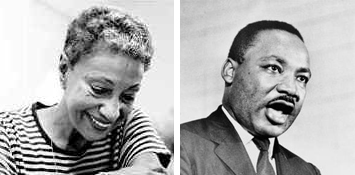
Martin Luther King, Jr. (Lib. of Congress, via Wikipedia)
Martin Luther King, Jr. would have been 81 years old today. I wanted to do a prompt this week which engaged thoughtfully (in some way) with his legacy—with the work that he began and which continues today—and so I was pleased to stumble upon Laura Gamache’s lesson plan, “The Right to Inquire” (on the Teachers & Writers Collaborative’s web site), in which she uses poetry as a means to link the questions about equality raised by the Civil Rights Movement with contemporary racial injustice for a group of children two generations removed from MLK’s era. In her three-part exploration, Gamache juxtaposed the big, outspoken rhetoric of the challenges raised in Langston Hughes’ poem, “Let America Be America Again” with the much-quoted rhetoric of Emma Lazarus’s “The New Colossus” and asked her students to write poems that engaged in different ways with questions about the slippery relationship between what we imagine or idealize as “freedom,” and the reality of the matter.
In may ways, I think that Gamache’s title, “The Right to Inquire,” touches a vein at the heart of the struggle for social justice as it continues today. Who has the right to raise difficult questions, or questions that nobody wants to hear? And who will have the courage to do so? In reading Hughes’ poem myself, I was struck not only by the questions that he raises (“Who said the free? Not me? /Surely not me? The millions on relief today? / The millions shot down when we strike? / The millions who have nothing for our pay?”), but also by the broad claims that he lays to the voices of those who (ought to) have the right to freedom, in order to argue that America has not been “itself,” or has not met its own precious standard of liberty, in which the call to equality rings foremost:
“I am the poor white, fooled and pushed apart,
I am the Negro bearing slavery’s scars.
I am the red man driven from the land,
I am the immigrant clutching the hope I seek–
And finding only the same old stupid plan
Of dog eat dog, of mighty crush the weak.
I am the young man, full of strength and hope,
Tangled in that ancient endless chain
Of profit, power, gain, of grab the land!
Of grab the gold! Of grab the ways of satisfying need!
Of work the men! Of take the pay!
Of owning everything for one’s own greed!
I am the farmer, bondsman to the soil.
I am the worker sold to the machine.
I am the Negro, servant to you all.
I am the people, humble, hungry, mean–
Hungry yet today despite the dream.
Beaten yet today–O, Pioneers!
I am the man who never got ahead,
The poorest worker bartered through the years.”
A quick update on some news we posted earlier this week: Kundiman has announced that the submission deadline for its poetry contest has been extended to February 16, 2009.
It’s the first Weekend Events Roundup of the New Year! (And of the decade, we might add).There’s a lot of things going on this weekend in the literary arts world. Monday (January 18th) is also Martin Luther King, Jr. Day. We hope that, in addition to considering what arts events you’d like to check out, you’ll also consider attending a celebratory event or participating in service or activism this weekend in honor of his work and legacy.
We posted about it in our December Holiday Roundup, but since the postmark deadline for Kundiman’s Poetry Prize is this week, we wanted to put out the call one last time.
From Sarah Gambito:
“Kundiman and Alice James Books will be accepting submissions of poetry manuscripts for The Kundiman Poetry Prize. The deadline is January 15, 2010.
The Kundiman Poetry Prize welcomes submissions from emerging as well as established Asian American poets. Entrants must reside in the United States.
The winner receives $2000, book publication and a feature New York City reading.”
Application guidelines can be found here. Or, read more about Alice James Books here.
As of December 23, 2009, the Lantern Review staff are taking a short break from the blog for the holidays. We will return on January 8, 2010. In the meantime, have a safe and joyous holiday season, and a very happy New Year.
Thank you so much for a fantastic first few months; it’s been an experience more wonderful than anything we could ever have imagined when we first planted the seeds of this project. We are incredibly grateful to you for your continued support and enthusiasm, and look forward to 2010 with great excitement. Happy Holidays!