For our Summer Reads series, we’ve asked contributors from Issue 1 to share what they’ve been reading or plan to read this summer. This installment features reads from Jai Arun Ravine.
Happy August! Here is our little news flash for the month:
Late Summer Blog Hiatus & LR Staff Changes
Our staff will be taking a blog hiatus from August 11th until September 6th. During our hiatus, we’ll be updating the web site, fine-tuning our submissions policies in preparation for the next reading period, making final decisions about our staff search, and welcoming our new staff onto our team. When we return in September, we’ll introduce our new team members and open submissions for Issue 2.
August Community Calendar Posted
In light of our upcoming blog hiatus, we’ve extended the range of our August Calendar to include events up through September 6th. If you know of something going on or would like to note a correction to an existing listing, please email or message us to let us know (we will still be responding to email during the hiatus, even though we won’t be on Facebook or Twitter as regularly as usual).
* * *
We’ll still be posting regularly up through August 10th, so in the meantime, keep on coming back for more poetry goodness. Many thanks to you, as always, for all of your support — having such a dedicated and enthusiastic community of readers has made our first year an incredible joy.
For our Summer Reads series, we’ve asked contributors from Issue 1 to share what they’ve been reading or plan to read this summer. This installment features a list of titles that were recommended to us by Eileen Tabios.
Writes Eileen,
“For another venue, I came up with a Summer reading list in poetry here . . .
From above list and for LR — I can recommend the following Asian American titles:
Juvenilia by Ken Chen (Yale University Press)
Far far above the typical poet’s first book. Admirably — and effectively — ambitious. Sophisticated. Will make you fall in love
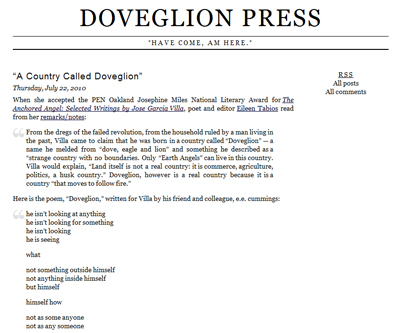
“Doveglion Press is an independent publisher of political literature and orature. We are committed to publishing aesthetically diverse and challenging works of strong artistic merit.
Doveglion, the pen name which Jose Garcia Villa crafted from the dove, eagle, and lion, is a fantastic and hybrid creature, signifying the writer’s ability to embody multitudes, and from splintered selves, to reinvent, and to reconstruct him/herself anew.
Future projects include a semi-annual print journal, interactive blog with rotating guest writers, and an audio/video gallery.”
Please do head on over to check out the rest of their blog entries. Personally, I’m loving their beautiful, spare site design, the force of Barbara & Oscar’s vision, and the operation’s small, focused feel (delightfully indie, immensely professional).
Congratulations, Barbara and Oscar! We can’t wait to read Issue One, and look forward to following Doveglion as it grows.
Part of an architectural plan for a library (via Wikipedia)
This week’s prompt has a shorter explanation than usual. I was simply very intrigued by Mei-Mei Berssenbrugge’s use of a particular building’s architecture to shape her poem “Permanent Home.” As Berssenbrugge engages with structural forms and technical language, the walls and beams of the house she’s describing become transparent, windows through which we can peek in at the speaker’s interior life while she peeks at us.
“The water tank sits on a frame of used wood, like a packing crate.
I look through it to an extinct volcano.
The panorama is true figuratively as space, and literally in a glass wall, where clouds appear like flowers, and the back-lit silhouette of a horse passes by.
A file of evergreens secures the cliff amid debris from a crew bilding, as at the edge of the sea.
Oranges, dumplings, boiled eggs take on the opaque energy of a stranger.
Knowledge as lintel, bond beam (model signs) holds the world at a distance.”
I love that last line, in particular. Berssenbrugge evokes such space and light with it. A home (even an imagined one) becomes a whole world, a place of origin and a vantage point from which one develops one’s perspective. And the lack of an actual physical structure to which to tie the speaker’s longing transforms the poem itself into a kind of home in which imagination dwells. A process that, I think, has particular resonance for me, not just as a child of diaspora, but as one such subject who writes.
Prompt: Write a poem that uses the architectural structure of a building as a frame or form by which to shape its content and imagery.
For our Summer Reads series, we’ve asked contributors from Issue 1 to share what they’ve been reading or plan to read this summer. This installment features a list sent to us by Tamiko Beyer.
Many thanks to Tamiko for sharing these titles with us. Check out her postcard poem in Issue 1’s special feature on Kundiman, or follow her online at her personal web site, www.wonderinghome.com, and at the Kenyon Review blog.
The following YouTube clip of a group of NYC poets surprising subway riders with guerrilla-style readings came to our attention via Issue 1 contributor Tamiko Beyer yesterday. I thought it was so absolutely freaking cool that I had to share it here:
These poets are part of a project called PUP, “Poets in Unexpected Places” or “Pop-Up Poets.” They do exactly what their name implies: pop up in unexpected public locations (like the subway, the Botanic Gardens, a supermarket) to read poetry. You can read about some of their experiences on their blog, in which they detail stories of people’s reactions to their performances. My favorite, I think, is their most recent post about a Q-train ride in which one of the riders got up and started dancing, while the rest of the car clapped and cheered! Such unexpected joy in the middle of a city that is known for its public mask of anonymity (the summer that I worked in Manhattan, we were distinctly advised by our HR trainers to put on a confident, stand-offish “subway face” while riding public transit in order to avoid sticking out). I love the idea of bringing poetry to public spaces at unexpected times, of incorporating it into the everyday rhythms of life in playful and soul-filled ways. PUP thrives on the idea that poetry is (and may at any time) be all around us, and that its wild spontaneity and beauty is something to be celebrated, all day, every day.
I love the idea of bringing PUP-style projects to other parts of the nation, too. Watching the video got me all revved up imagining what it would be like to have a PUP style group in quiet little South Bend, IN, or in my parents’ tiny hometown in NJ—wouldn’t it be cool if poets popped up in the middle of a bank lobby, or on the South Shore line or Riverline, or in front of the public library, or in the middle of a mall or a cafe or bar? Or even in the grocery lines at Costco or Meijer? Or in the different departments? You could have poets in all the aisles! Have you ever participated in a guerilla-style poetry project? If so, please do share your experience with us; we’d love to hear your stories!
DAILY s-PRESS is a web site that “explores + celebrates the landscape of small+indie presses with daily book features.” It is run by Dorothee Lang, the editor of BluePrintReview.Many thanks to Dorothee for this opportunity. Click here to read the rest of the feature.
For our Summer Reads series, we’ve asked contributors from Issue 1 to share what they’ve been reading or plan to read this summer. This installment features Rachelle Cruz’s summer reading list.
Rachelle says,
“Here’s my long list. A mix of poetry and mystery (I work at a specialty mystery bookstore):
A couple of weeks ago, we posted an imitation exercise, so I thought it would only be fitting to post that exercise’s opposite: writing an inversion. I’ve done this exercise a few times before, and on each occasion I’ve found it very difficult! The decisions one has to make about how to flip another poet’s meaning inside out and yet still remain somewhat faithful to the sonic/syntactical frame of the original poem and at the same time create a piece that has some aesthetic sense to it really stretch one’s abilities in all sorts of ways. Though I couldn’t imagine the results of any of my inversions as finished poems (I’m not yet good enough at the exercise to have made it really work for me!), I’ve often found myself being pleasantly surprised by the fresh aesthetic directions in which the exercise has pushed my language and has caused me to step out of myself. Often, I find that allowing myself the freedom to write what feels like complete nonsense truly makes me pay further attention to technicalities of sound and word choice.
Prompt: Write a poem that is an inversion of another poem. Take each line of the original poem and try to write its antithesis or opposite, subverting the original poet’s imagery and meaning while remaining as close to their rhythms and syntactical patterns as possible.
“Yes, some are fully clothed
but too large for even the boldest
black and white and since they are silent
and neither tuneful nor stoic, they are,
therefore, not any less than mirage, less
than illusion, less than truth.
They have not stood against stiff
white desert surfaces and stayed,
they have crumbled beneath the breath of equatorial steam, have failed to root
amidst loose radicals and reactive
salts, slipped away easily while coughing up
conjoined flesh. They are more whimsical
than concrete, far more solitary
than black holes (. . .)”
Another interesting possibility for the inversion exercise—one that I have yet to fully explore myself—is the opportunity that it might afford for a poet to “write back” at the politics of a poem representing a set of ideals that he or she might want to subvert. I’ve yet to find a poem that this would work well with for me (the success of the exercise depends as much on one’s choice of an original poem as it does on the execution!), but if you’ve tried this before successfully, I would love to hear about your experience—please do share your thoughts with us in the comments!