LR News: Apply to Blog for Us!

LR is looking for a handful of talented bloggers to add to its staff for next year. We seek strong writers with an interest in Asian American poetry and a knowledge of the contemporary literary scene. Prior blogging experience is not necessary, though it is a plus, as is experience with social media.

Positions Available

Book Reviewers: write short reviews of recent poetry collections. (Finding poetry reviewers is of a higher priority for us right now, but we are also open to considering reviewers who specialize in prose).

Columnists: choose a specialized topic of their choice to blog about on a monthly basis. Some topics we might be interested in exploring in the future include book arts, small press publishing, perspectives from students enrolled in creative writing programs, translation, poetry in the classroom, poetry and history — but we’re open to many more ideas, and if you have one that you think is good, pitch it to us!

Interviewers: conduct interviews with writers and editors; may also be asked to help coordinate guest post series (for example, see our “Process Profiles” series from May 2010).

Event Reporters: report on literary events of interest to readers. We’re especially interested in people who live in the vicinity of NYC, LA, and/or San Francisco for this position.

Requirements

  • Bloggers commit to writing 1 post a month during our academic year term (Sept through June, not including blog hiatuses), with a draft submitted via WordPress at least a week in advance of the post date to allow time for revision and proofreading.
  • Reliable, organized, responsible.
  • Ability to write clear, incisive, and critically astute (but accessible!) posts.
  • Familiarity with and ability to easily converse about issues of politics and poetics that are relevant to the Asian American poetry community.
  • Prior experience with blogging a big plus.
  • Familiarity with WordPress a plus, but definitely not necessary.
  • As we’re focused mostly on US and North American poetry, we would prefer to work with bloggers who are familiar with the literary scene in the US/Canada. Though we will definitely consider those living in other locations, too!

To Apply

Please send the following to us at editors [at] lanternreview (dot) com by JULY 23rd:

  • A cover letter introducing yourself and specifying the position(s) you are applying for (include in the body of your email). Tell us about yourself: where are you from, what is your area of training, what do you like to read, what have you written about in the past? As an LR staff blogger, what would you be interested in writing about? Pitch your ideas to us. Why would you be a good fit for us?
  • Your resume, highlighting any past experience with blogging, journalism, past work on literary magazines, and any publications.
  • A writing sample: 350-500 words of prose about poetry or Asian American issues — either from past article(s) or blog post(s), and/or from a scholarly essay.

Please note that as we are an all-volunteer operation, we regret that we cannot pay our bloggers, but we assure you that your experience on LR staff will be both professional and enriching, and will help you to gain both experience and exposure in the online literary scene.
Summer Reads: Issue 1 Contributor Desmond Kon

For our Summer Reads series, we’ve asked contributors from Issue 1 to share what they’ve been reading or plan to read this summer.  This installment features a list from Singaporean poet & ceramist Desmond Kon Zhicheng-Mingdé.

Desmond writes,

“Here’s my list (some books have arrived and others I’m requisitioning from the national library here) but these are the ones I’ve been excited about (there are others but they’ll have to wait for next year or something):

Power & Possibility: Essays, Reviews and Interviews (by Elizabeth Alexander)

Islamic Ceramics (by James W. Allan)

The Gate of Horn (by L. S. Asekoff)

Planisphere (by John Ashbery)

This Lamentable City (by Polina Barskova)

These Extremes (by Richard Bausch)

I Was the Jukebox (by Sandra Beasley)

The Collectors (by Matt Bell)

Approaching Ice (by Elizabeth Bradfield)

Plato’s Socrates (by Thomas C. Brickhouse & Nicholas D. Smith)

An Island of Fifty (by Ben Brooks)

Confusion: A Study in the Theory of Knowledge (by Joseph L. Camp, Jr.)

Until Before After (by Ciaran Carson)

Ceramic Materials: Science and Engineering (by C. Barry Carter)

One Kind of Everything: Poem and Person in Contemporary America (by Dan Chiasson)

Pierce the Skin (by Henri Cole)

Heterologies: Discourse on the Other (by Michel de Certeau)

When All Our Days Are Numbered (by Sasha Fletcher)

For the Fighting Spirit of the Walnut (by Takashi Hiraide)

The Living Fire (by Edward Hirsch)

Gender, Desire, and Sexuality in T. S. Eliot (by Cassandra Laity & Nancy K. Gish)

We Don’t Know We Don’t Know (by Nick Lantz)

Chinese Ceramics (by Stacey Pierson)

Long Lens (by Peter Makuck)

Tocqueville (by Khaled Mattawa)

The Stranger Manual (by Catie Rosemurgy)

Vinland (by Jamie Ross)

Living Must Bury (by Josie Sigler)

Postmodern Ceramics (by Mark Del Vecchio & Garth Clark)

Archicembalo (by G. C. Waldrep)

A lovely set of Mud Luscious Press chapbooks (by Eric Beeny, Matt Bell, Michael Berstein, Daniel Citro, Ryan Downey, David Gianatasio, Kuzhali Manickavel, Ben Segal)”

Many thanks to Desmond for sharing his reading list with us. Check out his poems, “first falling, to get here, ferric by foot” and “: craquelure at the interiors :” in Issue 1 of Lantern Review.

Here’s my list (some books have arrived and others I’m requisitioning from the national library here) but these are the ones I’ve been excited about (there are others but they’ll have to wait for next year or something):

Power & Possibility: Essays, Reviews and Interviews (by Elizabeth Alexander)

Islamic Ceramics (by James W. Allan)

The Gate of Horn (by L. S. Asekoff)

Planisphere (by John Ashbery)

This Lamentable City (by Polina Barskova)

These Extremes (by Richard Bausch)

I Was the Jukebox (by Sandra Beasley)

The Collectors (by Matt Bell)

Approaching Ice (by Elizabeth Bradfield)

Plato’s Socrates (by Thomas C. Brickhouse & Nicholas D. Smith)

An Island of Fifty (by Ben Brooks)

Confusion: A Study in the Theory of Knowledge (by Joseph L. Camp, Jr.)

Until Before After (by Ciaran Carson)

Ceramic Materials: Science and Engineering (by C. Barry Carter)

One Kind of Everything: Poem and Person in Contemporary America (by Dan Chiasson)

Pierce the Skin (by Henri Cole)

Heterologies: Discourse on the Other (by Michel de Certeau)

When All Our Days Are Numbered (by Sasha Fletcher)

For the Fighting Spirit of the Walnut (by Takashi Hiraide)

The Living Fire (by Edward Hirsch)

Gender, Desire, and Sexuality in T. S. Eliot (by Cassandra Laity & Nancy K. Gish)

We Don’t Know We Don’t Know (by Nick Lantz)

Chinese Ceramics (by Stacey Pierson)

Long Lens (by Peter Makuck)

Tocqueville (by Khaled Mattawa)

The Stranger Manual (by Catie Rosemurgy)

Vinland (by Jamie Ross)

Living Must Bury (by Josie Sigler)

Postmodern Ceramics (by Mark Del Vecchio & Garth Clark)

Archicembalo (by G. C. Waldrep)

A lovely set of Mud Luscious Press chapbooks (by Eric Beeny, Matt Bell, Michael Berstein, Daniel Citro, Ryan Downey, David Gianatasio, Kuzhali Manickavel, Ben Segal)

LR News: July 2010 Updates

We’re a few days late in getting this July update posted, but it’s officially full-swing summer for us at LR, and we’ve been pleased as punch (flabbergasted, more accurately) at the response to Issue 1 so far!  Thank you so much to all of you who have helped to spread the word.

Here’s are some things that you can expect to see on the blog this month:

July Community Calendar UpdatedYour Feedback Wanted

This month, we’ve added two cities: Portland and San Antonio.  As always, we would love your help in posting any updates or additions: simply leave us a comment or send us an email.  Please note that we will be trying out a new policy: for this month, any updates to the calendar will be made on the 15th, so let us know of anything you want us to add before then.  We’d also like to have your feedback on another proposed change: hitherto, our goal has been to post each month’s new ComCal on the 1st of the month (or, in cases in which the 1st falls over a weekend, the Monday immediately following).  We’ve discovered that updating a few days after the first of the month makes it easier for us to compile a more detailed calendar (since most literary newsletters come out on the 1st of the month, and arts organizations tend to update their event calendars on the first or second).   Should we start putting up our Community Calendar updates on, say—the 3rd or 4th of the month—or do you think we would be better off sticking to our old plan?  Please leave us a comment to let us know what you think.

Summer Reads, Indivisible Series Continue

We’ve had lots of responses from our Issue 1 contributors, and so we’ll be continuing to post the summer reading lists they’ve sent to us periodically throughout July.  LR Staff Writer Supriya Misra will also be finishing up her two-part series about the Indivisible anthology, so look out for her post towards the end of the month.

LR Blog Staff Search

One of our goals for the next year is to grow our blog, which means that we will soon be looking to fill new positions on our team of staff writers! Please keep your eyes peeled: we’ll be putting up a post with details about how to apply very soon.

Weekly Prompt: Letter to My Country

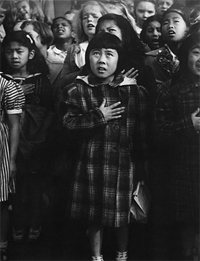
Dorthea Lange's iconic Pledge of Allegiance image (via Wikipedia)

I recently visited the MOMA in New York City, where I had the chance to see a print of Dorthea Lange’s famous image of a Japanese American girl reciting the Pledge of Allegiance hanging in their photography gallery.  Lange’s photo, taken during the Internment era, when Japanese Americans’ loyalty, Constitutional freedoms—and indeed, their human dignity—were under extreme duress, serves as a witness to the injustices of the past, but also reminds us of the fact that we, despite our often-difficult political relationship to this nation that we claim as our home, are a part of it.  That we participate in the making of the messy narrative that is American history, and that the narratives that make up the history of this nation are necessarily entangled with our own.  In short, this is our America, too.

Independence Day is coming up, and in thinking about our history as Americans of color, I’m inspired by the fraught complexity of the relationship between nation and speaker that exists this poem by Claude McKay [text via the Poetry Foundation]:

America

by Claude McKay

Although she feeds me bread of bitterness,
And sinks into my throat her tiger’s tooth,
Stealing my breath of life, I will confess
I love this cultured hell that tests my youth.
Her vigor flows like tides into my blood,
Giving me strength erect against her hate,
Her bigness sweeps my being like a flood.
Yet, as a rebel fronts a king in state,
I stand within her walls with not a shred
Of terror, malice, not a word of jeer.
Darkly I gaze into the days ahead,
And see her might and granite wonders there,
Beneath the touch of Time’s unerring hand,
Like priceless treasures sinking in the sand.

Prompt: Write a poem in the form of a letter to your country.

Summer Reads: Issue 1 Contributors Craig Santos Perez & Henry W. Leung

For our Summer Reads series, we’ve asked contributors from Issue 1 to share what they’ve been reading or plan to read this summer. This week’s installment features reads from Craig Santos Perez and Henry W. Leung.

Writes Craig,

” . . . here are three books that i just read for this summer:

Thirteen Ways of Looking at the Bus, Gizelle Gajelonia (Tinfish Press)
Shout Ha! to the Sky, Robert Sullivan (Salt)
Zong! M. Nourbese Philip (Wesleyan)”

Henry says,

“I’m working on a Fulbright application for a research novel in China,
so my reading for the next week will be research on the little that’s
been written in English about contemporary (actual contemporary, not
heavily political post-Mao post-CR) China. They include:

Yiyun Li – A Thousand Years of Good Prayers
Shouhua Qi – Red Guard Fantasies and Other Stories
Xiaolu Guo – Lovers in the Age of Indifference
Deanna Fei – A Thread of Sky (product of a 2002 Fulbright in China)
Geling Yan – The Banquet Bug

and translations:
New Generation: Poems from China Today
Pearl Jacket and Other Stories: Flash Fiction from Contemporary China

Many thanks to Craig and Henry, for sharing their reading lists with us.  You can check out Henry’s poem “Question for a Painter” and Craig’s review of Skirt Full of Black in Issue 1 of Lantern Review.

Weekly Prompt: Imitation

"Warhol Troopers": Artist Mike Stimpson does Warhol's famous Marilyn portrait in Lego - with a little Star Wars twist.

One of the most productive creative writing exercises that I was assigned in college was to write an imitation of Charles Wright’s poem “Clear Night.” My instructor did not give many specific instructions, other than to use the form of the poem as a type of “template” for my own.  I struggled incredibly with the assignment at first, but eventually decided to simply follow (approximately), the rhythms and repetitions of Wright’s syntax.  Once I had decided that, and chosen an opening image, I found that the content of the poem found itself.  When I first started to write,  the poem was (oddly) about mouth ulcers — but somehow that evolved into a vision of a body riddled with the effects of radiation sickness.

In particular, I found myself drawn by Wright’s magnetic use of anaphora: “And the wind says “What?” to me. / And the castor beans, with their little earrings of death, say “What?” to me. / And the stars start out on their cold slide through the dark. / And the gears notch and the engines wheel.”  I followed these patterns closely with my own lines: “But the earth grew deaf to her. / And the ore, with its necklace of fallen particles, grows dim to her. / And the moon grows cold, and the wind shifts / And a thought slips from her fingers.”

What began as an exercise in imitation became the poem “Marie Curie, Dying,” the poem that began my obsession with writing about science and that would, in time, become the first poem of my MFA thesis.

Prompt: Write a poem that closely imitates a well-known poem, using that poem’s the sonic, rhythmic, and/or textural moves as a “template” or “form” for your own.

Summer Reads: Issue 1 Contributors Jon Pineda & Barbara Jane Reyes

Welcome to our new Summer Reads blog series!  We recently asked our contributors from Issue 1 to share with us what they are reading  / what’s on their reading lists this summer, and we’ll be featuring their responses here throughout the months of June and July.  This first installment features reads from Jon Pineda & Barbara Jane Reyes.

Writes Jon,

“I just finished Yoko Ogawa’s beautiful novel The Housekeeper and the Professor.”

Barbara tells us,

“I am finishing up Miguel Syjuco’s debut novel Ilustrado. Otherwise, I’m supporting some of my favorite indie publishers —

Albert Saijo, Outspeaks: A Rhapsody (Bamboo Ridge Press)
Michelle Cruz Skinner, In the Company of Strangers (Bamboo Ridge Press)
Gizelle Gajelonia, Thirteen Ways of Looking at The Bus (Tinfish Press)
Elizabeth Soto, Eulogies (Tinfish Press)
Craig Santos Perez, from unincorporated territory [saina] (Omnidawn Press)
Lily Hoang, Changing (Fairy Tale Review Press)
Reginald Dwayne Betts, Shahid Reads His Own Palm (Alice James Books)
Olga García Echeverría, Falling Angels: Cuentos y Poemas (Calaca Press)
Eduardo Galeano, Soccer in Sun and Shadow (Verso Books)

I am also reading Evie Shockley’s manuscript of her forthcoming second poetry collection, the new black.”

Check out Jon’s poem, “[we left the camera]” and Barbara ‘s pieces, “13. Black Jesus” and “10. For Al Robles” in Lantern Review, Issue 1.  For more information on the poets themselves, visit them online at jonpineda.com and barbarajanereyes.com, respectively.

LR News: Issue One Is Now Live!

LR Issue 1

At long last, the inaugural issue of Lantern Review is now live on our web site!

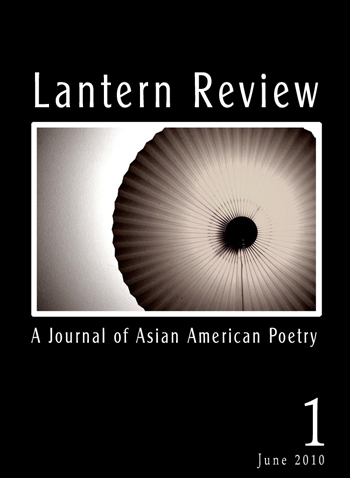
We’re thrilled to be able to present a volume of more than 30 extraordinary pieces, in a wide range of styles, and by poets of multiple generations.  Contributors to this issue include Eileen Tabios, Jon Pineda, Barbara Jane Reyes, Luisa Igloria, Angela Veronica Wong, Changming Yuan, Melissa Roxas, Sankar Roy, Subhashini Kaligotla, Vanni Taing, Rachelle Cruz, Jai Arun Ravine, Craig Santos Perez, as well as many others.  The issue also includes a special feature devoted to work created in the context of Kundiman’s vibrant community, in the form of our Community Voices section.  Before entering the issue, you might want to take a moment to check out our recommendations for optimum viewing, located here.  If you want to proceed to the issue right away, click here or on the cover image at the top left of this post.

We are still very much learners when it comes to producing and supporting a web-hosted magazine, so we’d appreciate any feedback or questions you might have about readability and navigation issues. (Feel free to drop us a line via email).

Thank you so much to all of you for your continued support, enthusiasm, and patience as we’ve wrestled with the process of making our dream become a reality.  We are honored to have the opportunity to present such a stellar body of work in our very first issue, and hope that you will enjoy reading it as much as we enjoyed putting it together.

Many thanks again,

Iris & Mia
LR Editorial Board

Weekly Prompt: Poems About Fruit

The remains of a kiwi

I’m spending a some time at my parents’ place at the moment, and one of the things that always characterizes home for me is the overabundance of fruit that my family likes to keep in the house — on top of the microwave, in the fridge, on the butcher block, on the floor next to the butcher block, in cardboard boxes in the garage.  We really love our fruit — we eat lots of it after every meal, and lots of different kinds.  This week alone, the five of us here have demolished a number of mangoes, a large pineapple, half a giant watermelon, a honeydew melon, and much of a large box of strawberries (we’ve yet to break into the large papaya next to the counter but I suspect that it’s slated to appear at tonight’s evening meal).  Fruit may seem like an odd topic for a poetry blog — but I assure you that it’s much less far-off than it may sound.  It occurred to me recently just how many famous poems have been written about fruit — Li-Young Lee’s “Persimmons,” Gary Soto’s “Oranges,” William Carlos Williams’ “This Is Just to Say,” and Robert Frost’s “After Apple-Picking” are just a few that come to mind (Poets.org has a list of many more).  And then there is the Biblical association of the fruit that stems from original sin, the folk associations in many traditions between fruit and fertility.  Fruit, it seems, is a subject that has the potential to draw out longing, desire, sensual pleasure — both epicurean and sexual — for the writer.  And writing about encounters with different kinds of fruit and with different ways of preparing them (as in Lee’s “Persimmons”) may be a way of engaging with cultural difference, alienation, or homesickness, as well. I never thought much of eating papaya, pomelo, longan as a child — but it was fruit like these that I would find myself missing the most deeply years later when I grew up and moved away.

Prompt: Write a poem about a fruit whose associations figure significantly in your memories of a particular person, time, or place.

LR News: Sneak Preview of Issue One

Hello, all!  If you’ve noticed that the LR blog has been unusually quiet in the past couple of weeks, please accept our apologies.  We have been hard at work putting together Issue One and most of our energy as of late has been consumed with carefully laying out and coding each page.  We’re currently finishing up with inputting a few last poems and ironing out some bugs in the code, but should still — if everything goes smoothly from here on out — be on track to release on time on Monday.  In the meantime, please enjoy this exclusive sneak peek at our cover design:

Other features to look forward to include poetry by Luisa Igloria, Barbara Jane Reyes, Eileen Tabios, Jai Arun Ravine (as well as many, many more), a special feature highlighting collaborative work from Kundiman, and a book review by Craig Santos Perez.